Social Fetch is a unified social media API. One API key returns public TikTok, Instagram and YouTube data, plus 54 other platforms, in the same { data, meta } envelope. Every lookup reports lookupStatus, requestId and creditsCharged in the same place, so your code handles found, not found and private results once for every network. You don't need a developer account or OAuth on any platform. New accounts get 100 free credits with no card, and every credit pack covers every platform.
Last checked: 15 Nov 2026. Social Fetch is our product. Every fact below comes from our live pricing, platform and docs pages on that date, and the sources are listed at the end.
What is a unified social media API?
A unified social media API gives you one way to read data from many social networks: one credential, one response shape and one bill, instead of a separate integration per platform. On Social Fetch the shared shape is the { data, meta } envelope. data holds what you asked for, and meta holds the request id, the credits charged and the API version. Errors use a separate { error } envelope with a typed code.
Unified doesn't mean every platform returns identical fields. A TikTok profile and a YouTube channel don't share every nested key, and an API that pretends they do has to throw information away. What stays the same is the wrapper and the outcome fields, and shared ideas such as handle, displayName and verified use the same names. Our glossary entry on the unified schema makes the same point: one parser for the envelope, with nested payloads that differ by resource.
Unified data APIs vs unified posting APIs
Two different kinds of product both get called a unified social media API, and search results often mix them up:
| Unified data API | Unified posting API | |
|---|---|---|
| What it does | Reads public profiles, posts, comments, search and transcripts | Publishes and schedules posts, reads analytics |
| Whose accounts | Any public account | Accounts you or your users connect |
| Auth | Your API key | OAuth for each connected account |
| Typical users | Data, research, monitoring and AI agent teams | Social media management tools |
Social Fetch is a data API. It reads public data and cannot publish posts or send messages. If you need to post to your own accounts on several networks, you want a posting API instead, and many teams use one of each.
One request, three platforms: a worked example
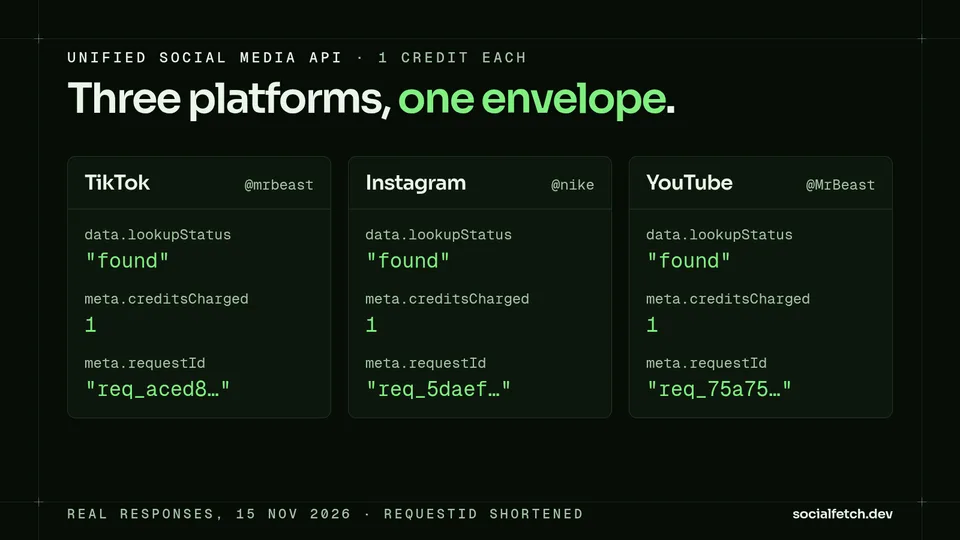
Here's one job done on three networks: look up a public account and read its audience size. Each request is one GET with your key in the x-api-key header, and each costs 1 credit. The responses below are the examples published in our docs, trimmed, so the counts show the shape and won't match today's numbers.
TikTok profile
Instagram profile
GET /v2/instagram/profiles/{profile} takes a handle, a profile URL or a numeric user id:
YouTube channel
GET /v1/youtube/channel takes a channel url, a handle or a channelId:
What is shared and what differs
The envelope is identical in all three. data.lookupStatus, meta.requestId and meta.creditsCharged sit at the same path every time, and fields like handle, displayName, verified and profileUrl use the same names. The nested paths are not all the same, though, and you should plan for that before you write the parser:
| Field | TikTok | Instagram (v2) | YouTube |
|---|---|---|---|
| Outcome | data.lookupStatus | data.lookupStatus | data.lookupStatus |
| Outcome values | found, private,not_found | found, private,not_found | found,not_found |
| Account object | data.profile | data.profile | data.channel |
| Handle | data.profile.handle | data.profile.handle | data.channel.handle |
| Platform id | data.profile.platformUserId | data.profile.id | data.channel.platformUserId |
| Audience | data.metrics.followers | data.profile.metrics.followers | data.metrics.subscribers |
| Content count | data.metrics.posts | data.profile.metrics.posts | data.metrics.videos |
| Request id | meta.requestId | meta.requestId | meta.requestId |
| Credits charged | meta.creditsCharged | meta.creditsCharged | meta.creditsCharged |
| API version | meta.version isv1 | meta.version isv2 | meta.version isv1 |
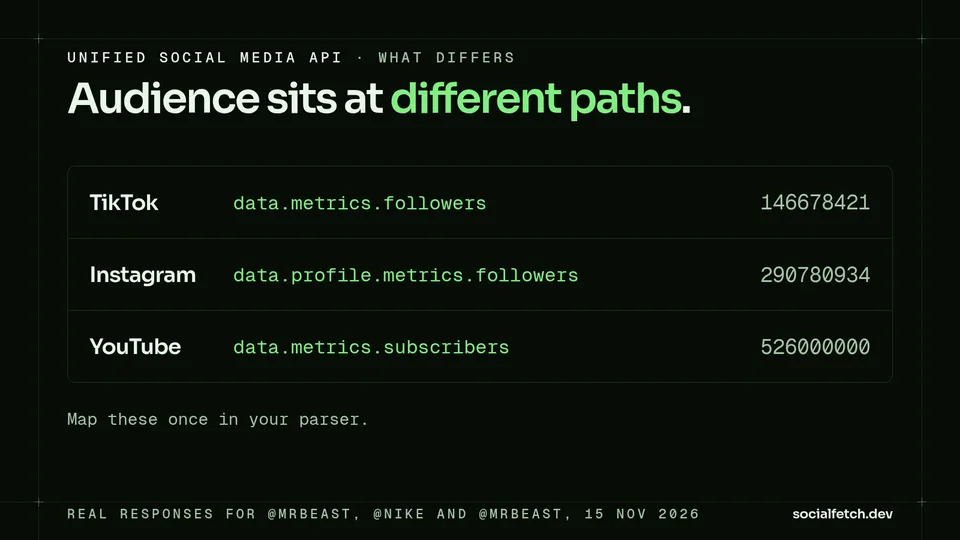
In practice you write one small mapping per platform for the payload and share everything else. A sketch of the audience mapping in TypeScript:
Logging, billing, retries and the found or not found branch can live in one shared function, since those fields sit at the same path on every platform.
Handling outcomes once: lookupStatus, errors and requestId
Every Social Fetch response has one of two shapes. When the request worked you get { data, meta }, and when it didn't you get { error } with a code, a message and a requestId. So the order in your code is the same for every platform:
Check the HTTP status.
On
200, readdata.lookupStatus:foundmeans the data is there,not_foundmeans the target doesn't exist or couldn't be identified,privatemeans it exists but isn't public, andrestricted(rare) means it exists but can't be returned.On anything else, read
error.codeand logerror.requestId.
A not_found profile is a completed lookup, not an error. It comes back as HTTP 200 and is charged at the normal price. Validation errors, 502 lookup_failed and 503 temporarily_unavailable responses are not charged. Under heavy load a 503 comes back with a Retry-After header telling you when to try again. When your balance is empty, metered routes return 402 insufficient_credits. The errors docs list every code.
One detail worth handling: some list routes return an empty list for a profile with no posts and for a private one alike. When the difference matters, call the profile route first, read its lookupStatus, and only call the list route when the profile was found.
What you can build on one schema
Social listening across platforms
Search routes cover discovery on each network: GET /v1/tiktok/search and /v1/tiktok/search/hashtags, GET /v2/instagram/reels/search and /v2/instagram/hashtags/{hashtag}/media, and GET /v1/youtube/search and /v1/youtube/search/hashtags. They all return the same envelope, so one ingestion job can read all three.
To skip the cron job, use monitors. A monitor is a source, a schedule and a webhook: it watches an account, channel or search, compares each check with the last one, and sends a signed webhook only when something new appears. You can monitor X, Instagram, TikTok, Reddit, Bluesky, Threads, Telegram and YouTube. Webhooks are signed with HMAC-SHA256, failed deliveries are retried 8 times over about 21 hours, and a dryRun create shows the credits per check, per day and per month before anything runs. See the monitoring use case.
Tracking influencer follower counts over time
Follower tracking is a scheduled profile lookup. Store the audience field from the mapping above with a timestamp, once a day or once a week, and chart the difference. A daily snapshot of one creator on TikTok, Instagram and YouTube costs 3 credits a day, one per platform. The influencer data use case covers the fuller version with posts and engagement.
For X, the X Follower Tracker does this inside the Social Fetch app with no code. It records an account's whole audience once, then checks it on a schedule and shows who followed, who left and who came back.
Feeding AI agents
Agents get the same envelope through the hosted MCP server at https://api.socialfetch.dev/mcp, which signs in with OAuth and bills tool calls like the REST routes. While an agent is still exploring, POST /v1/ask takes a plain-English question, routes it to the matching endpoint for 0 credits, bills the nested lookup at its normal price, and returns data.routedOperation so the agent can call that route directly next time. See social data for AI agents.
Which platforms one key covers
One key covers 57 platforms, including TikTok, Instagram, YouTube, Facebook, Pinterest, LinkedIn, X (Twitter), Threads, Bluesky, Reddit, Rumble, Twitch, Snapchat, Telegram, Linktree, Hacker News, Truth Social, Spotify, Apple Music, GitHub, Google Ad Library, Amazon and web extraction routes. The full list, with each platform's routes and credits, is on platforms.
What it costs
You pay per lookup in credits, and every credit pack covers every platform. There's no per-platform upsell. Most lookups cost 1 credit, and heavier routes, such as LinkedIn profiles at 3, list their cost in the docs and in meta.creditsCharged.
Pay-as-you-go packs never expire: Starter is $14 for 1,000 credits, Growth $59 for 25,000 and Scale $379 for 230,000. If you'd rather have a fixed bill, monthly plans run from Starter at $29 for 18,000 credits to Scale at $225 for 150,000, and the Scale annual plan brings the rate down to $1.35 per 1,000 credits (pricing). New accounts get 100 free credits with no card, and 250 more when you save a card (nothing is charged).
Paid metered /v1/* routes have no request quotas. Your credit balance is the limit, and a workspace can have up to 200 requests in flight at once.
Questions to ask any unified social media API vendor
Use these to compare any provider, including us:
Does every platform return the same envelope, with the outcome, request id and charge at fixed paths?
Are not found, private and restricted results typed outcomes, or empty objects you have to guess about?
Which responses are charged, and which aren't? Is a completed not found lookup billed?
Does one key and one balance cover every platform, or is each network a separate plan?
Do pay-as-you-go credits expire?
Are responses synchronous, or do you start a job and poll for results?
Is there an OpenAPI spec, an official SDK and a playground?
Is it a data API or a posting API, and does that match what you're building?
FAQ
Is there one API for TikTok, Instagram and YouTube data?
Yes. Social Fetch returns public TikTok, Instagram and YouTube data, plus 54 other platforms, with one API key in one { data, meta } envelope. A profile or channel lookup on each costs 1 credit.
What is a unified social media API?
An API that reads many social networks through one credential, one response shape and one bill. On Social Fetch the shared parts are the envelope, data.lookupStatus, meta.requestId and meta.creditsCharged. Nested fields still follow each platform.
What is the difference between a unified social media API and a social media management API?
A unified data API like Social Fetch reads public data from any account with your API key. A management or posting API publishes, schedules and reads analytics for accounts you connect with OAuth. Social Fetch cannot publish posts.
Which social media API is best for social listening as a developer?
Social Fetch gives you keyword and hashtag search on TikTok, Instagram and YouTube in one envelope, plus monitors that send a signed webhook when a watched account, channel or search has something new.
What is the best API to track influencer follower counts?
Run a scheduled profile lookup on Social Fetch and store the audience field: data.metrics.followers on TikTok, data.profile.metrics.followers on Instagram and data.metrics.subscribers on YouTube. Each lookup costs 1 credit.
Is there a pay-as-you-go social media API?
Yes. Social Fetch credit packs are one-time purchases that never expire, starting at $14 for 1,000 credits, with no subscription required.
Do I need a developer account on each platform?
No. You authenticate with a Social Fetch API key in the x-api-key header. There's no TikTok, Meta or Google Cloud app to set up.
Does one API key cover every platform, or do I pay per platform?
One key and one balance cover all 57 platforms. Every credit pack includes every platform.
How do I handle not found and private accounts across platforms?
Read data.lookupStatus on every 200 response. It uses the same values across platforms: found, not_found, private, and rarely restricted. Each route's docs list the values it uses. A completed not_found or private lookup is charged.
Can AI agents use a unified social media API?
Yes. Social Fetch has a hosted MCP server with OAuth, and POST /v1/ask routes plain-English questions to the right endpoint for free, billing only the nested lookup.
Try Social Fetch free
Platform-specific guides
Sources, checked 15 Nov 2026
Social Fetch: pricing and its FAQ; credits; errors; quickstart; TikTok profile, Instagram profile and YouTube channel docs; platforms; YouTube hub; unified schema; monitoring; X Follower Tracker; MCP; POST /v1/ask; social data for AI agents; llms.txt

The Social Fetch team publishes shipping notes, API design essays, and production post-mortems for developers who need live social and web data without running scrapers.
Related articles


Questions about this post? Contact us.