Picking a social media scraping API is mostly picking which problem you want to own: proxies, parsers, or neither. I run Social Fetch, so I ranked it first, and I say where it loses. Everything else below is checked against each vendor's live pricing page and docs on 27 September 2026, and the reliability numbers come from 459,253 real production requests, not a demo.
TL;DR: the best social media scraping APIs by use case
Best overall for developers and AI agents: Social Fetch. 233 endpoints across 23 platforms, one JSON envelope, synchronous responses, credits that never expire.
Cheapest per request at high volume: ScrapeCreators ($0.99 per 1,000 on its $497 pack) or Bright Data ($1.50 per 1,000 records pay-as-you-go).
Best for custom or niche scrapers: Apify. Thousands of Actors, but every Actor has its own output schema.
Best for enterprise procurement and SLAs: Bright Data or Oxylabs.
Best if you already run proxy infrastructure: Decodo (formerly Smartproxy).
Best for steady daily TikTok/Instagram/YouTube volume on a subscription: EnsembleData.
The 10 best social media scraping APIs at a glance
| # | API | Type | Best for | Social platforms | Entry price | Free tier | Credits expire? |
|---|---|---|---|---|---|---|---|
| 1 | Social Fetch | Managed social API | Multi-platform apps and AI agents | 23 | $29 / 15,000 credits | 100 credits, no card | No (packs) |
| 2 | SociaVault | Managed social API | Small projects, pay-as-you-go | 25+ sources | $29 / 6,000 credits | 50 credits | No |
| 3 | ScrapeCreators | Managed social API | Cheapest per call at 500k+ | 10+ (37+ APIs) | $47 / 25,000 credits | 100 credits | No |
| 4 | EnsembleData | Managed social API | Steady daily volume | 8 | $100/mo (1,500 units/day) | 50 units/day trial | Daily reset |
| 5 | Apify | Scraper marketplace | Custom and niche scrapers | Any (per Actor) | $19/mo + usage | $5/mo usage | Monthly |
| 6 | Bright Data | Enterprise scraper + proxies | High volume, datasets, compliance | 12 | $1.50 / 1,000 records | 5,000 records/mo | PAYG |
| 7 | Decodo | Proxy-first scraping API | Teams that want raw HTML/JSON | Templates for major sites | $19/mo | 2,000 requests | Monthly |
| 8 | Oxylabs | Enterprise scraping API | SLAs and procurement | Instagram, Facebook, YouTube targets | $49/mo | 2,000 results | Monthly |
| 9 | ScraperAPI | General web scraping API | E-commerce and general web | Generic URLs | $49/mo | 1,000 credits | Monthly |
| 10 | RapidAPI | API marketplace | Prototyping one endpoint fast | Varies by listing | Varies | Varies | Varies |
Prices are the lowest self-serve paid option on each vendor's pricing page as of 27 Sep 2026. "Credits" mean different amounts of work at each vendor: a Bright Data record, an EnsembleData unit, an Apify compute unit and a Social Fetch credit are not interchangeable. The cost-per-1,000 table further down normalises what can be normalised.
How I evaluated these APIs
I scored each tool against seven criteria that decide whether an integration survives production, not whether the landing page looks good:
Verifiable platform coverage. Counted from a public endpoint list or docs, not a marketing number. Ad libraries and shops are not "Instagram".
Output consistency. Does the follower count come back under the same field name on TikTok and Instagram, or do you write an adapter per platform?
Sync vs async. Can a UI or an agent wait for one HTTP response, or do you start a job, poll it and download a dataset?
Reliability. Published success rates, independent benchmarks (Proxyway's 2025 Web Scraping API Report, AIMultiple's 75,000-request social benchmark) and, for Social Fetch, our own production logs.
Billing clarity. What bills on a failed or empty lookup, and whether unused credits expire.
Price per 1,000 requests at entry level and at the largest self-serve tier.
AI-agent readiness. MCP server, SDKs, stable JSON, request IDs you can hand to support.
What I did: read each vendor's pricing page and API docs on 27 Sep 2026; called the Social Fetch API live for the examples in this post; pulled 14 days of Social Fetch production logs; and checked the current US Google results for "best social media scraping API" to see which vendors buyers actually compare.
What I did not do: run a controlled head-to-head benchmark with paid accounts at every vendor. Where I quote a competitor's reliability, it comes from the independent benchmarks above, and I name the source. If you run one, send it over and I'll add it.
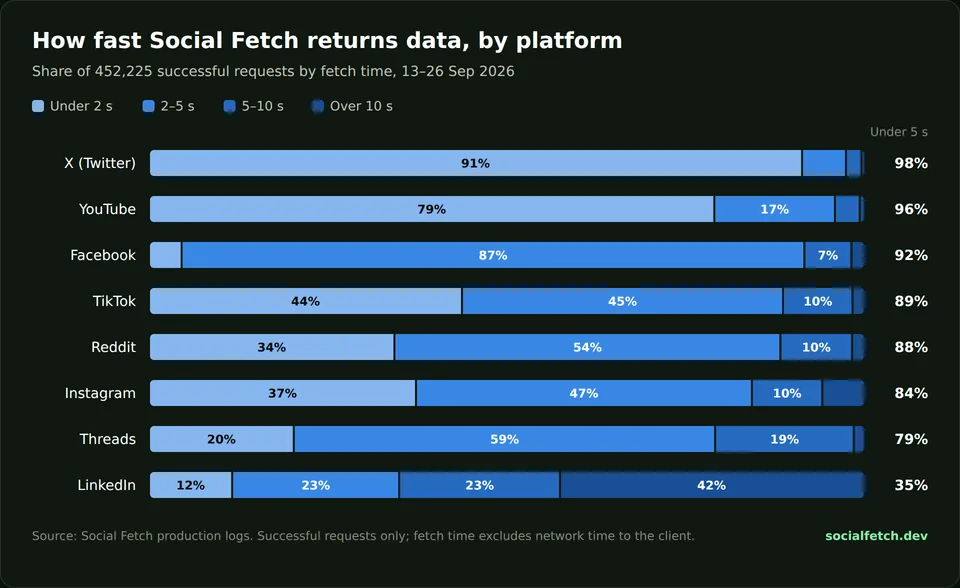
Social Fetch production reliability: 459,253 requests
Most listicles say "reliable" without a number. Here is ours: every request made to the eight most-used platforms on Social Fetch between 13 and 26 September 2026 (UTC).
| Platform | Requests | Success rate | Under 3 s | Under 5 s | Mean fetch time |
|---|---|---|---|---|---|
| 135,737 | 99.98% | 49% | 92% | 3.5 s | |
| TikTok | 103,356 | 93.83%* | 56% | 89% | 3.1 s |
| 65,133 | 99.98% | 64% | 88% | 3.1 s | |
| 50,210 | 99.83% | 62% | 84% | 3.4 s | |
| YouTube | 47,429 | 99.64% | 86% | 96% | 1.8 s |
| 38,760 | 99.42% | 25% | 35% | 10.5 s | |
| X (Twitter) | 17,696 | 99.36% | 95% | 98% | 1.1 s |
| Threads | 932 | 100% | 35% | 79% | 3.7 s |
| All eight | 459,253 | 98.47% | 86% | 3.7 s |
*TikTok had an upstream incident between 13 and 15 September that failed 6,322 requests. Outside that window TikTok ran at 99.91%. Excluding it, all eight platforms combined ran at 99.83%. Failed requests were not billed.
How to read this: a "success" is any completed lookup (HTTP 200), including a completed not_found for a handle that doesn't exist. A failure is a 5xx where we could not complete the fetch. Client-side errors (bad parameters, empty balance, rate limits) are excluded because they never reach the platform. Fetch time is the time spent retrieving from the platform and excludes network time between you and our API.
Where we're slow: LinkedIn. Only 35% of LinkedIn lookups finish under five seconds, because LinkedIn profile routes do more work per call. If sub-second LinkedIn is a hard requirement, no managed API I know of offers it for full profiles.
The 10 best social media scraping APIs, reviewed
1. Social Fetch: best overall for multi-platform apps and AI agents
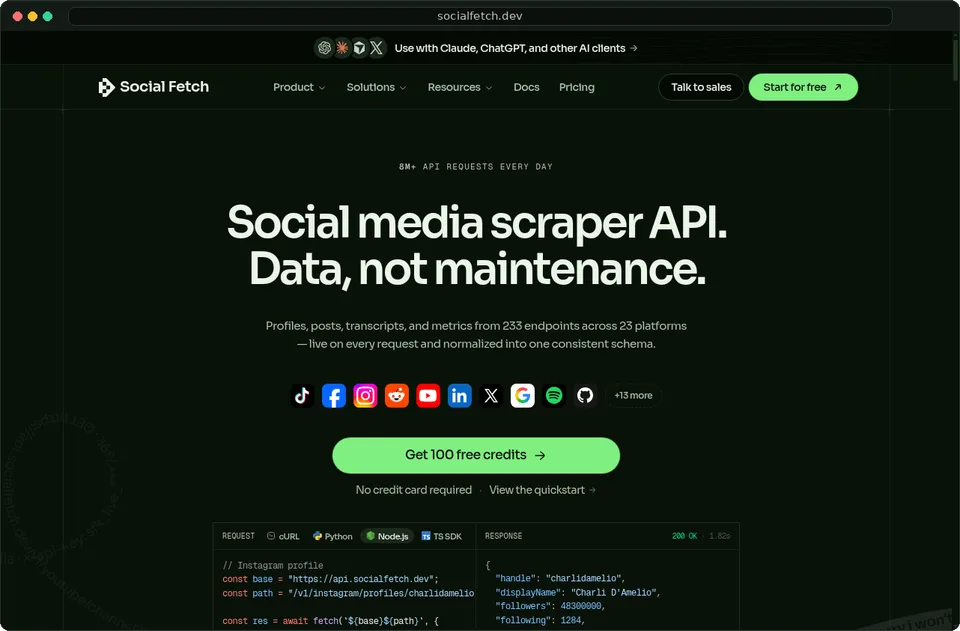
Best for: product teams, data teams and AI agents that need TikTok, Instagram, YouTube, X, LinkedIn, Facebook, Reddit and more through one integration.
Social Fetch is a managed REST API. You send a handle or URL, we run the scrapers, proxies and parsers, and you get JSON back in the same HTTP response. There's one API key, one credit balance and one { data, meta } envelope on every one of the 233 endpoints across 23 platforms. The capability matrix lists every route.
What stands out
Coverage depth, not just breadth. 41 LinkedIn endpoints, 30 TikTok, 29 X, 21 Facebook, 20 Instagram, plus Reddit, Threads, Telegram, Truth Social, Bluesky, Pinterest, Twitch, Rumble, Hacker News, GitHub, Spotify, Apple Music, SoundCloud, Linktree, Amazon, Google ad data and web extraction.
Consistent field names. Profiles use
profile.handle,profile.bioandmetrics.followerson TikTok, Instagram and X. You add a platform by changing the URL, not the parser.Honest billing. Completed lookups bill, including
not_foundd. Failed fetches (llookup_failed,503) and validation errors never touch your balance. Every response showsmeta.creditsCharged.Built for agents. An MCP server with one tool per route plus docs search, a TypeScript SDK, an n8n node, and
meta.requestIdon every response.Monitoring. Monitors watch accounts and send signed webhooks when they post, so you don't have to poll.
Watch out for
Not the cheapest per request at 500,000+ calls a month. ScrapeCreators and Bright Data undercut us there.
LinkedIn is slow (see the table above) and LinkedIn profiles cost 3 credits.
No pre-computed engagement rate or reach estimates. You get raw counts and do the maths.
Not every platform uses identical field names: YouTube channels return
metrics.subscribers, notfollowers, and X returnstweetswhere TikTok returnsposts.
Pricing (source): 100 free credits, no card. Subscription plans from Starter $29/mo (15,000 credits), Growth $79/mo (50,000), Scale $225/mo (150,000) — annual pricing available too. Pay-as-you-go packs are also available for one-off usage and never expire: 1,000 credits for $14, 25,000 for $47 ($1.88 per 1,000), 230,000 for $379 ($1.65 per 1,000). Most routes cost 1 credit.
Verdict: the right default if you need more than two platforms, want one parser instead of ten, or are wiring social data into an AI agent.
2. SociaVault: simple pay-as-you-go for small projects
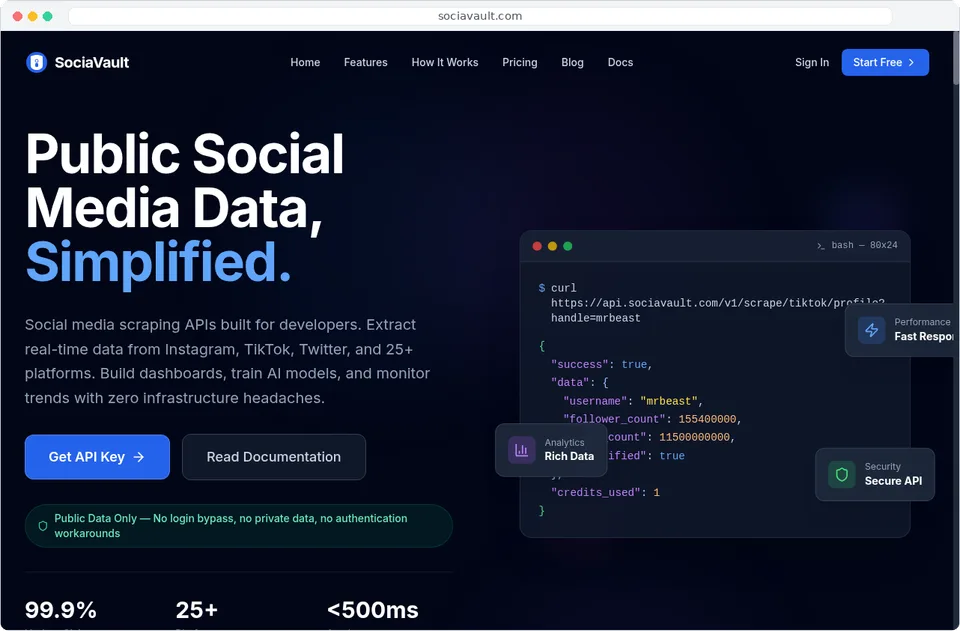
Best for: side projects and small teams that want non-expiring credits without a subscription.
SociaVault sells credit packs that never expire and lists 25+ sources, including Snapchat, Kick and ad libraries. Getting a first call working is quick.
Watch out for: the entry pack is expensive per call ($4.83 per 1,000) and even the $399 pack works out to $2.00 per 1,000, above both Social Fetch and ScrapeCreators at scale. There's no MCP server. See our SociaVault comparison.
Pricing (source): 50 free credits. $29 for 6,000; $79 for 20,000; $199 for 75,000; $399 for 200,000.
Verdict: fine for low volume and platforms like Snapchat or Kick that others don't cover. Expensive once you scale.
3. ScrapeCreators: cheapest managed API at high volume
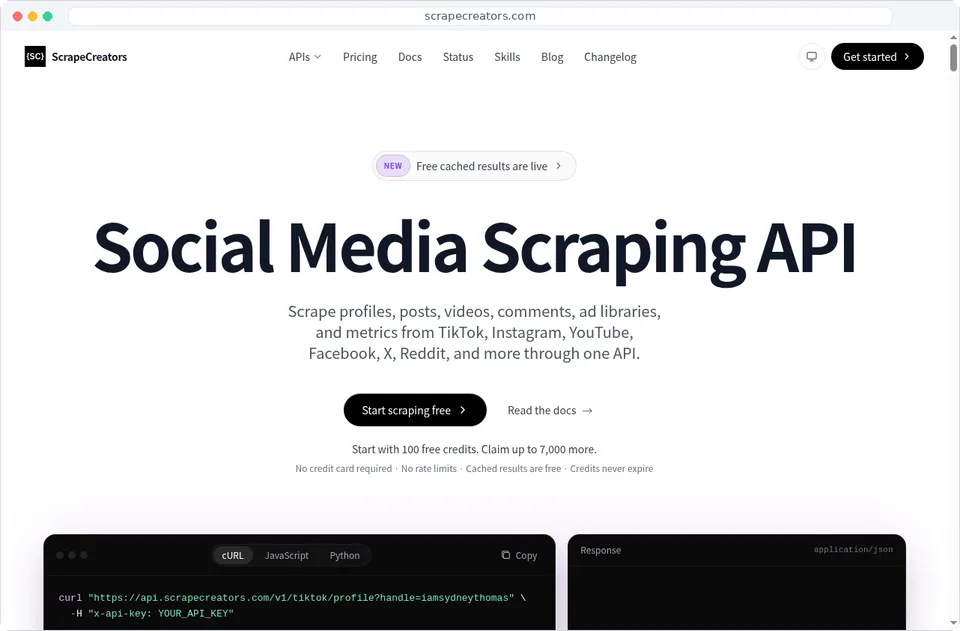
Best for: high-volume TikTok, Instagram and YouTube workloads where cost per call is the deciding factor.
ScrapeCreators is the closest product to Social Fetch: a managed REST API with pay-as-you-go credits that never expire and an MCP integration. Its $47 pack matches our Growth price exactly (25,000 credits), and its $497 pack for 500,000 credits works out to $0.99 per 1,000, which beats our Scale pack. It also doesn't charge for cached results.
Watch out for: a smaller catalogue (for example 22 TikTok endpoints versus our 30), and I couldn't find published per-platform success rates. Below 500,000 calls a month the price is the same as ours.
Pricing (source): 100 free credits. $47 for 25,000 credits; $497 for 500,000; custom above 1M.
Verdict: pick it if you mostly need TikTok and Instagram at very high volume. Pick Social Fetch if you need LinkedIn, Facebook or many platforms in one schema.
4. EnsembleData: best for steady daily volume
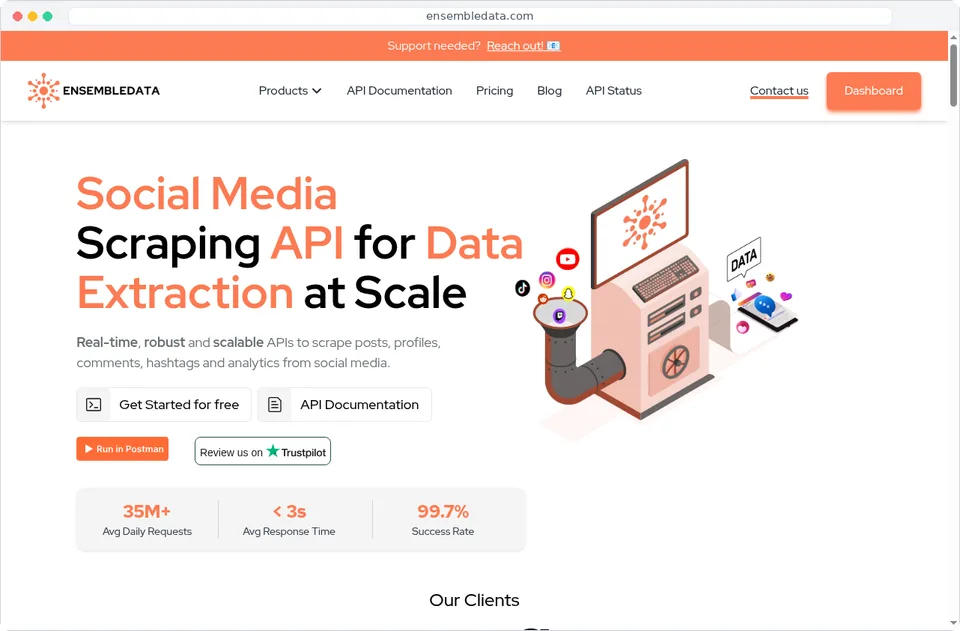
Best for: influencer and creator-analytics platforms with predictable daily usage on TikTok, Instagram and YouTube.
EnsembleData covers eight platforms (TikTok, Instagram, YouTube, Threads, Reddit, Twitch, X and Snapchat) and says it's used by major influencer-marketing platforms. It prices by daily "units" on a monthly subscription, and failed requests caused by internal errors don't use units.
Watch out for: units reset every day at 00:00 UTC, so spiky or batch workloads waste budget. No LinkedIn or Facebook. Unit costs vary by endpoint. See our EnsembleData comparison.
Pricing (source): 50 units/day free trial. $100/month for 1,500 units a day, up to $1,400/month for 50,000 a day.
Verdict: good when volume is flat and predictable. A poor fit for bursty jobs.
5. Apify: best for custom and niche scrapers
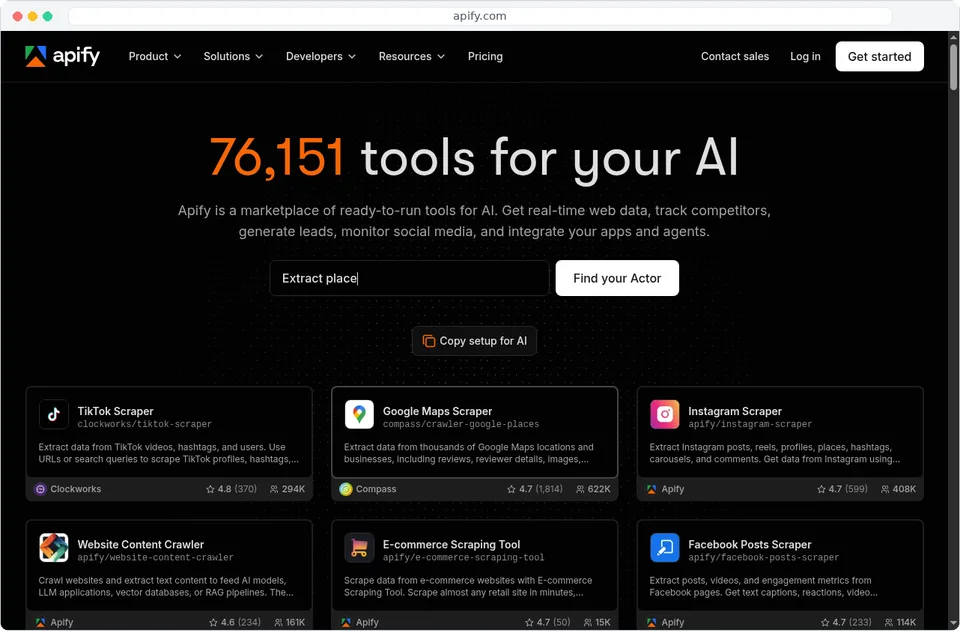
Best for: one-off extraction jobs, niche sites and scheduled batch crawls where you want control over the scraper.
Apify is a scraper marketplace and runtime, not a social data API. You pick an Actor (a community or official scraper), configure its input, start a run, wait, and download a dataset. There is an Actor for almost anything, plus the open-source Crawlee library and an MCP server.
Watch out for: every Actor returns its own schema, so three platforms usually means three parsers. Billing mixes monthly plans, compute units and per-result fees, and unused plan credits expire at the end of each billing cycle. Actor quality varies by author. See Social Fetch vs Apify.
Pricing (source): free plan with $5/month of usage. Starter $19/month, Scale $199/month, Business $999/month, each including that amount of usage.
Verdict: pick Apify when the scraper you need doesn't exist as a managed endpoint. Accept that normalisation is your job.
6. Bright Data: best for enterprise volume and datasets
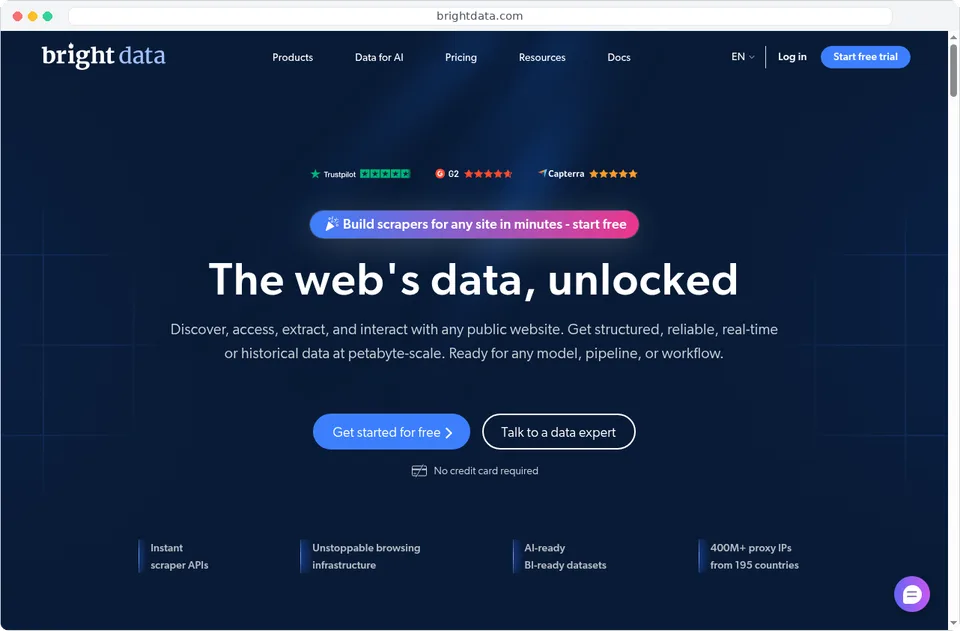
Best for: large teams that need very high volume, bulk datasets, cloud-storage delivery and a compliance story for procurement.
Bright Data sells proxies, unblocking and ready-made scrapers. Its social media scraper API covers 12 platforms (Instagram, TikTok, LinkedIn, Facebook, YouTube, X, Reddit, Pinterest, Snapchat, Bluesky, Vimeo, Quora) and returns results synchronously or via webhook, with delivery to S3, GCS, Azure or Snowflake. In AIMultiple's social benchmark it scored 88% success at about 8 s per request, a better speed-to-reliability balance than the slower Decodo.
Watch out for: each scraper has its own output shape, the product surface is large, and support and contracts are built for enterprise buyers. See Social Fetch vs Bright Data.
Pricing (source): 5,000 records a month free. $1.50 per 1,000 records pay-as-you-go; $499/month for 384,000 records.
Verdict: the safe pick for a large company buying at scale. Heavy for a startup shipping one feature.
7. Decodo (formerly Smartproxy): best proxy-first option
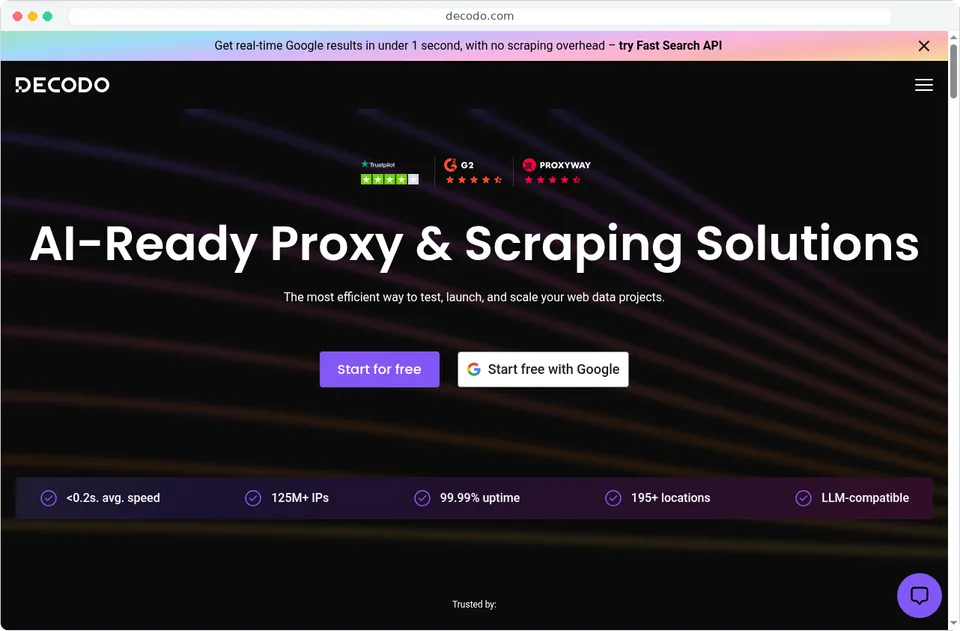
Best for: teams that already run their own parsers and want a scraping API that handles proxies and anti-bot.
Decodo's scraping API rotates proxies, renders JavaScript and ships templates for popular sites, returning HTML, JSON, CSV or Markdown. It had the highest success rate in AIMultiple's social benchmark (91.2%) but was slower (about 24 s per request), and ranked in the top four in Proxyway's 2025 report.
Watch out for: you generally get page data, not a normalised social schema, so parsing and upkeep stay with you. Cost depends on proxy tier and rendering.
Pricing (source): free plan with 2,000 requests. Paid plans from $19/month; roughly $0.14 to $1.50 per 1,000 requests depending on features.
Verdict: strong unblocking at a good price, if you're happy to own the parsers.
8. Oxylabs: best for SLAs and procurement
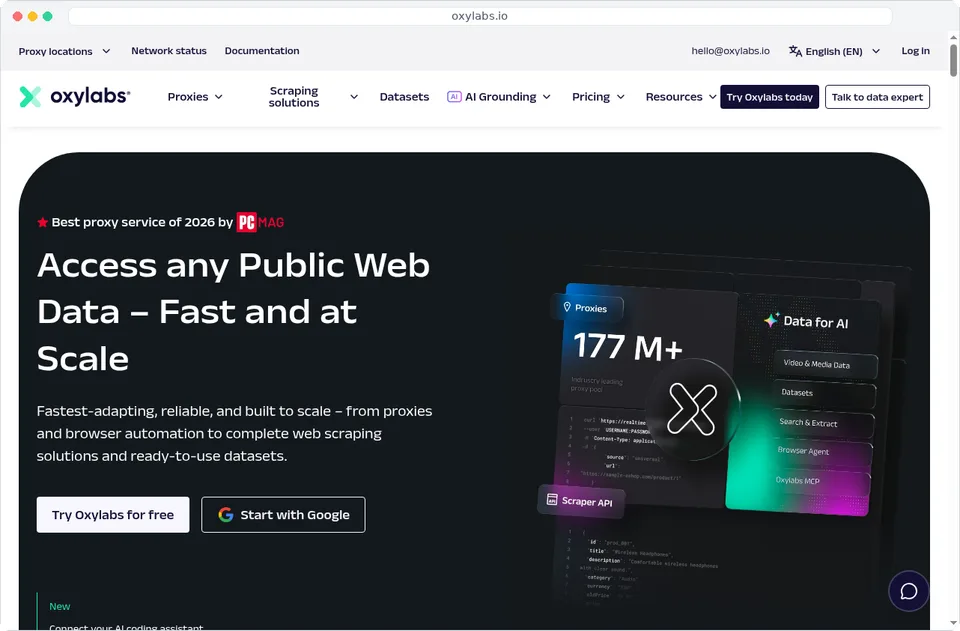
Best for: enterprises with SLA requirements, security reviews and a procurement process.
Oxylabs' Web Scraper API returns parsed JSON or raw HTML and lists Instagram, Facebook and YouTube among its targets. It was one of four providers above 80% overall success in Proxyway's 2025 benchmark. See Social Fetch vs Oxylabs.
Watch out for: social coverage is narrower than dedicated social APIs, and there's no shared schema across platforms.
Pricing (source): free trial up to 2,000 results. Micro $49/month, Starter $99/month, Business $999/month.
Verdict: justified at enterprise scale. More than most developer projects need.
9. ScraperAPI: best for general web scraping, not social
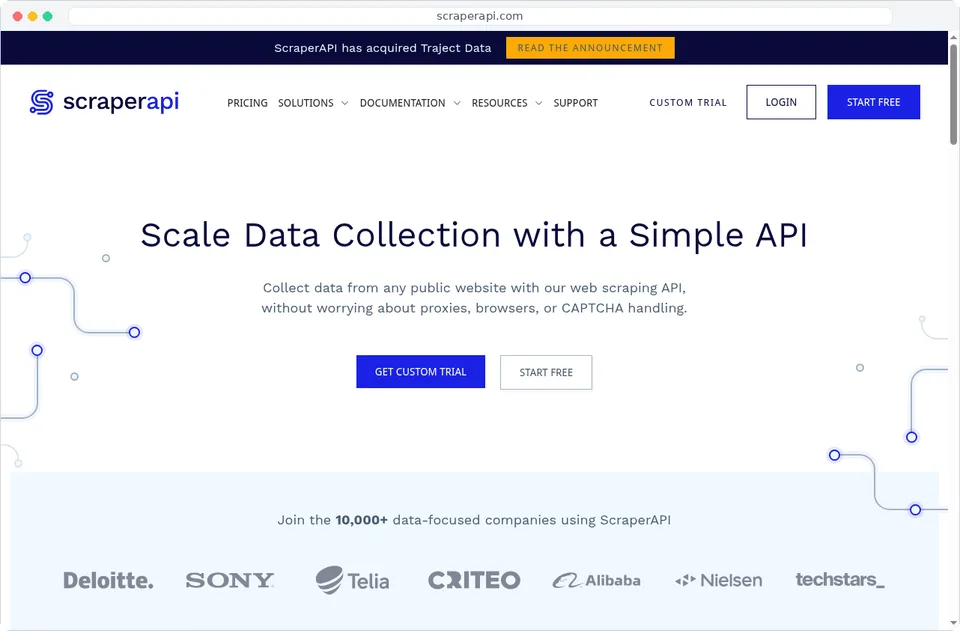
Best for: e-commerce, search and general websites.
ScraperAPI handles proxies, CAPTCHAs and rendering for any URL. It's simple, well documented and was the second-fastest API in Proxyway's 2025 report. For social targets it's a weaker fit: it wasn't among the four providers above 80% success in that report, you parse the pages yourself, and LinkedIn requests cost 30 credits each. See Social Fetch vs ScraperAPI.
Pricing (source): 1,000 free credits plus a 7-day, 5,000-credit trial. Hobby $49/month for 100,000 credits; unused credits don't roll over.
Verdict: use it for Amazon and Google. Use a social-first API for social.
10. RapidAPI: best for prototyping a single endpoint
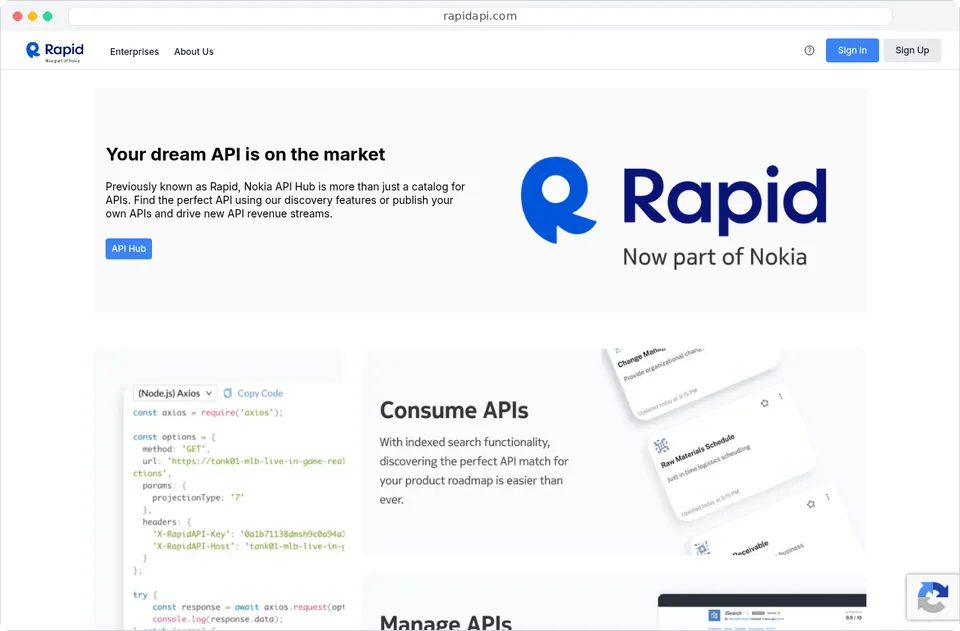
Best for: finding one niche endpoint quickly for a weekend prototype.
RapidAPI (now Rapid, part of Nokia) is a marketplace of third-party APIs, including many unofficial TikTok and Instagram ones. It's fast for discovery, but each listing has its own schema, pricing, reliability and support, and listings disappear. See Social Fetch vs RapidAPI.
Verdict: good for exploring. Risky as production infrastructure.
Also considered
These came up in research but didn't make the top 10 for this use case: Scrapfly and ScrapingBee (strong general scraping APIs, parsing is yours), Data365 (enterprise social data API, sales-led), PhantomBuster (no-code automation for growth teams, not an API for developers) and Zyte (fastest unblocker in Proxyway's report, general web). Every comparison is in our compare hub.
Which type of social media scraping API do you need?
The ten tools above fall into four categories. Choosing the category first rules out most of the list.
| You need to… | Category | Good options | Main trade-off |
|---|---|---|---|
| Show social data in your app or feed it to an AI agent | Managed social API | Social Fetch, ScrapeCreators, SociaVault, EnsembleData | Limited to the endpoints the vendor ships |
| Scrape a niche site or run custom batch crawls | Scraper marketplace | Apify | One schema per scraper; async runs |
| Buy data at enterprise scale with SLAs | Enterprise scraper + proxies | Bright Data, Oxylabs | Cost and complexity |
| Keep your own parsers, outsource unblocking | Proxy / unblocker API | Decodo, ScraperAPI, Zyte | You maintain parsers when sites change |
If you're not sure, start with a managed social API. Maintaining your own Instagram parser is the most common reason a scraping project stalls.
What a unified schema looks like in practice
The same creator on three platforms, through each platform's own data format:
| Field | TikTok (native) | Instagram (native) | YouTube Data API | Social Fetch |
|---|---|---|---|---|
| Followers | stats.followerCount | edge_followed_by.count | statistics.subscriberCount | metrics.followers (YouTube: metrics.subscribers) |
| Handle | uniqueId | username | customUrl | profile.handle |
| Bio | signature | biography | snippet.description | profile.bio |
With Social Fetch, the request is the same shape for every platform. Only the path changes:
A real response from 27 Sep 2026, trimmed:
Swap tiktok for instagram and the same parser reads metrics.followers (89,731,621 on the same day). Try it without writing code in the playground.
What it actually costs per 1,000 requests
Only the managed APIs with per-request pricing can be compared directly. Apify, Decodo, Oxylabs and ScraperAPI depend on the scraper, proxy tier or target site.
| API | Entry pack | Cost per 1,000 at entry | Largest self-serve tier | Cost per 1,000 at that tier |
|---|---|---|---|---|
| Social Fetch | $14 / 1,000 | $14.00 ($1.88 on the $47 pack) | $379 / 230,000 | $1.65 |
| ScrapeCreators | $47 / 25,000 | $1.88 | $497 / 500,000 | $0.99 |
| SociaVault | $29 / 6,000 | $4.83 | $399 / 200,000 | $2.00 |
| Bright Data | Pay-as-you-go | $1.50 (per 1,000 records) | $499/mo / 384,000 | $1.30 |
| EnsembleData | $100/mo / ~45,000 units | ~$2.22 per unit if fully used | $1,400/mo / ~1.5M units | ~$0.93 per unit if fully used |
Two things change the real cost more than the headline rate:
Expiry. Monthly plans and daily units lose value if your usage is spiky. Social Fetch, ScrapeCreators and SociaVault packs never expire.
What bills. Ask whether empty results, failed fetches and retries cost credits. On Social Fetch, only completed lookups bill.
Official APIs vs scraping APIs
Official APIs are the right choice when they cover your use case. For public data about accounts you don't own, they usually don't:
| Platform | Official API limitation |
|---|---|
| Instagram (Graph API) | Only accounts you own or manage; see Instagram Graph API vs Social Fetch |
| X (Twitter) | Paid tiers with monthly read caps; see X API vs Social Fetch |
| TikTok | Research and partner APIs require an application |
| Most useful endpoints are partner-only | |
| YouTube Data API | 10,000 quota units a day by default |
| Paid for commercial use since 2023; see Reddit API vs Social Fetch |
Is social media scraping legal?
Collecting publicly available data is generally lawful in the US, and hiQ Labs v. LinkedIn is the case most often cited for that. But platform terms of service still apply, logging in to scrape changes the picture, and GDPR and similar laws apply to personal data about people in the EU and UK whatever the source. Scrape only public data, collect only what you need, and get advice for your jurisdiction. This isn't legal advice.
Questions to ask any vendor before you buy
How many platforms, really? Open the endpoint list, not the landing page.
One schema or many? Call two platforms with the same parser. If you need
if (platform === "instagram"), it isn't unified.Sync or async? Do you get data in the response, or a job ID to poll?
What bills? Empty results, failures and retries.
Do credits expire? Monthly and daily resets raise the real price for spiky workloads.
What are the success rates on the platforms you need? Ask for numbers per platform, not an overall average.
Frequently asked questions
What is the best social media scraping API in 2026?
For most developers and AI agents, Social Fetch: 233 endpoints across 23 platforms, one JSON format, synchronous responses and credits that don't expire. ScrapeCreators is cheaper at very high volume, Apify is better for custom scrapers, and Bright Data suits enterprise procurement.
What is the cheapest social media scraping API?
At high volume, ScrapeCreators ($0.99 per 1,000 on its $497 pack) and Bright Data ($1.30 to $1.50 per 1,000 records). To start for free, Social Fetch (100 credits) and ScrapeCreators (100 credits) need no card, and Bright Data gives 5,000 records a month.
Is there an API that returns Instagram, TikTok and YouTube data in the same format?
Yes. Social Fetch returns profiles from TikTok, Instagram and X with the same field names (profile.handle, metrics.followers), in the same { data, meta } envelope. YouTube channels use the same envelope with metrics.subscribers.
Why do my social media scrapers keep breaking?
Platforms change page structure, internal APIs and bot detection frequently; Instagram and TikTok are the worst for this. A managed API moves that maintenance to the vendor. If you keep your own scraper, expect to fix it every few weeks.
Do I need proxies to scrape social media?
If you build your own scraper, yes: residential proxies and browser fingerprinting are close to mandatory for Instagram, TikTok and LinkedIn. Managed APIs such as Social Fetch, ScrapeCreators and Bright Data include proxies in the price.
What's the best social media API for AI agents?
One with an MCP server, stable JSON and clear errors. Social Fetch ships an MCP server with one tool per endpoint plus docs search, and every response carries a request ID and credit count the agent can read. Apify and ScrapeCreators also offer MCP.
Apify vs Bright Data vs Decodo: which is better for social media?
Apify is best when you need a specific community scraper and don't mind a different output per Actor. Bright Data is best for enterprise volume and datasets. Decodo had the highest success rate in AIMultiple's social benchmark but returns data you parse yourself. If you want parsed, consistent JSON across platforms, a managed social API is simpler than any of the three.
Should I build my own social media scraper?
For a one-off research script, yes. For anything in production, a managed API is usually cheaper once you count proxy costs and the hours spent fixing breakages.
Platform-specific guides
Sources
Vendor pricing pages, checked 27 Sep 2026: Social Fetch, ScrapeCreators, SociaVault, EnsembleData, Apify, Bright Data, Decodo, Oxylabs, ScraperAPI
Proxyway, Web Scraping API Report 2025 (11 providers, 15 protected sites, tested October 2025)
AIMultiple, Best Social Media Scrapers: 75K Requests Tested (updated August 2026)
Social Fetch production logs, 13 to 26 Sep 2026 (459,253 requests)
Changelog
27 Sep 2026: Full rewrite. Added TL;DR, methodology, 14-day Social Fetch reliability data with a fetch-time chart, homepage screenshots for every vendor, cost-per-1,000 table and decision matrix. Added ScrapeCreators and EnsembleData; removed ProfileSpider (a browser extension, not an API) and moved Scrapfly to "also considered". Re-checked every vendor's pricing.
3 Sep 2026: First published.
Ready to test it? Get 100 free credits, no card required, and make your first call in the playground.

Founder of Social Fetch. Writes about social-data APIs, reliability, and the production incidents that forced better timeouts, envelopes, and billing.
Related articles
Questions about this post? Contact us.