

PhantomBuster alternative: LinkedIn and social data by API, billed per lookup
LinkedIn, TikTok and Instagram data as JSON from one API call. Pay per lookup — no execution hours, slots or monthly plan.
Social Fetch
GET /v2/linkedin/profiles?handle={handle}
Profile JSON in the response, no LinkedIn login
{
  "displayName": "Satya Nadella",
  "headline": "Chairman and CEO at Microsoft",
  "followers": 15000000,
  "connections": 500,
  "location": "Redmond, Washington, United States"
}
1 request · 3 credits per LinkedIn profile · no plan needed
PhantomBuster
Set up a Phantom
Pick an automation, connect your LinkedIn session, set inputs
Launch it and wait
Runs in the cloud on execution hours and a slot
Export the results
Download CSV/JSON, or fetch the output by API
Billed in execution hours · plans from $69/mo
Teams running monitoring, research, and enrichment pipelines


Why Social Fetch
Why teams switch from PhantomBuster.
When the job is data for your backend, not an automation playbook.
One API for every network
LinkedIn, TikTok, Instagram, YouTube and X behind one key and the same response envelope, so your backend code doesn't change per platform.
Pay per lookup, not per hour
One price per completed lookup (LinkedIn profiles are 3 credits). No execution hours or slots to size up front.
Data in the request, not a run
Call the endpoint from your backend and read the JSON — no Phantom to launch, no export to wait for.
No LinkedIn session to keep alive
Requests run on our infrastructure, not your LinkedIn account. There's no session cookie to refresh when it expires.
Made for backends, not playbooks
Concurrent requests with explicit statuses and request IDs, built to sit inside your product.
No monthly plan to size up front
Start with 100 free credits and pay as you go — credits never expire. Running lookups every month? A monthly plan lowers the per-credit rate.
What teams build on the API instead
Enrichment, monitoring and research that live in your backend, not in an automation dashboard.
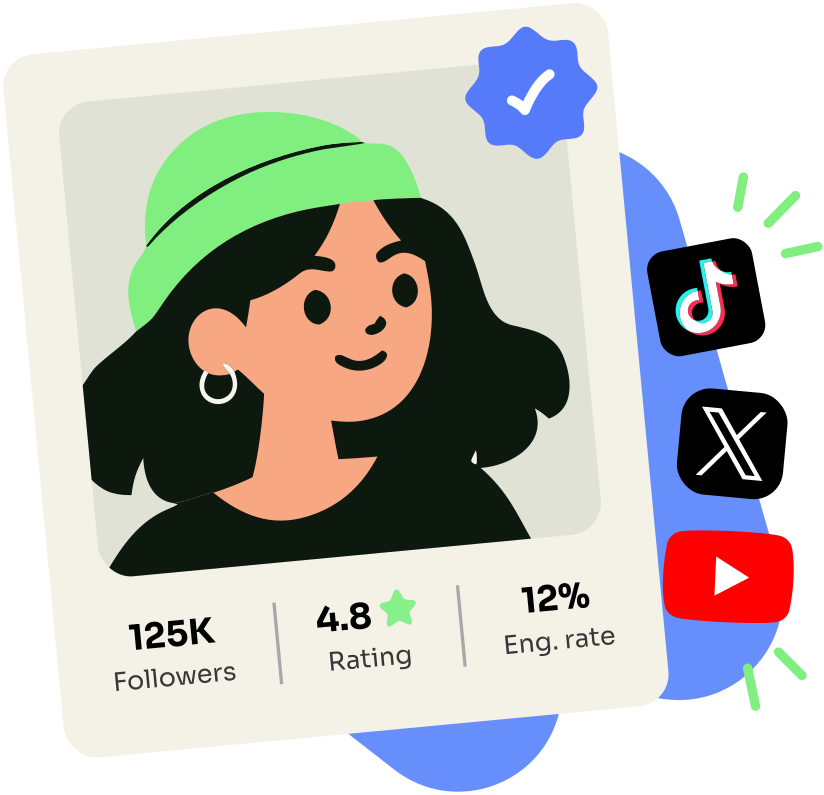
Enrich people and creators
LinkedIn profiles next to TikTok, Instagram and YouTube stats, returned in one request.
Monitor brands and competitors
Watch accounts on a schedule and get a signed webhook when something new posts.
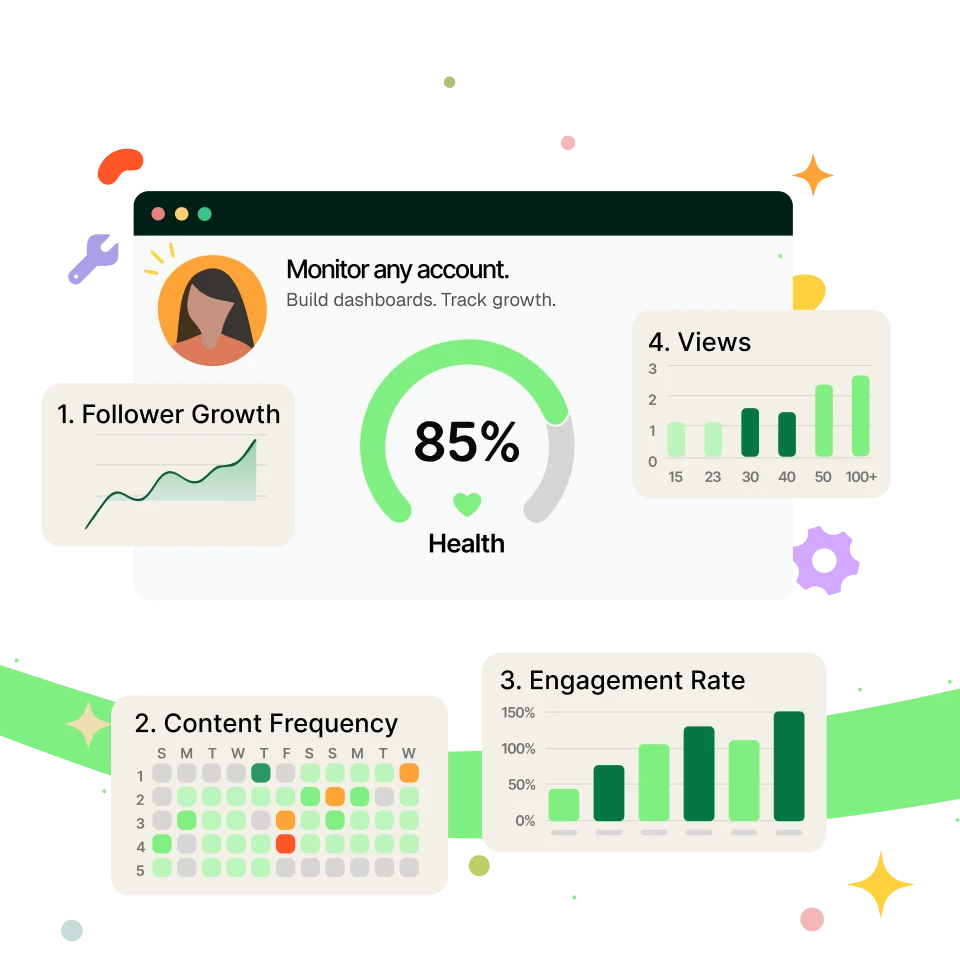
Client reports from one key
Track public communities
Follow the subreddits, groups, and channels where your audience talks.

Execution hours vs per-lookup credits
PhantomBuster prices runtime; Social Fetch prices results. If you know how many profiles you need, you know what Social Fetch will cost — with no monthly plan to keep paying.
Social Fetch
from$1.35
per 1,000 credits (1 per TikTok or Instagram profile, 3 per LinkedIn profile)
- No card to start
- Credits never expire
- Failed lookups aren't billed
PhantomBuster
$69/mo
for PhantomBuster Start: 20 execution hours and 5 Phantom slots
75k TikTok or Instagram profile lookups
1 credit per lookup.
- Social Fetch
- ~$124 at the Scale pack rate
- PhantomBuster
- Depends on Phantom runtime — hours, not rows
25k LinkedIn profile lookups
LinkedIn profiles are 3 credits each (75,000 credits).
- Social Fetch
- ~$124 at the Scale pack rate
- PhantomBuster
- Depends on Phantom runtime — hours, not rows
Monthly floor
- Social Fetch
- None on PAYG
- PhantomBuster
- $69+ once you leave free/trial limits
LinkedIn outreach sequences
- Social Fetch
- Wrong tool
- PhantomBuster
- Core use case
Embed in a SaaS backend
- Social Fetch
- Designed for this
- PhantomBuster
- Possible via API — still automation-shaped
Export limits on free/trial
- Social Fetch
- Full API within credit balance
- PhantomBuster
- 10-row cap on free/trial exports
| Scenario | Social Fetch | PhantomBuster |
|---|---|---|
| 75k TikTok or Instagram profile lookups1 credit per lookup. | ~$124 at the Scale pack rate | Depends on Phantom runtime — hours, not rows |
| 25k LinkedIn profile lookupsLinkedIn profiles are 3 credits each (75,000 credits). | ~$124 at the Scale pack rate | Depends on Phantom runtime — hours, not rows |
| Monthly floor | None on PAYG | $69+ once you leave free/trial limits |
| LinkedIn outreach sequences | Wrong tool | Core use case |
| Embed in a SaaS backend | Designed for this | Possible via API — still automation-shaped |
| Export limits on free/trial | Full API within credit balance | 10-row cap on free/trial exports |
PhantomBuster prices checked 23 September 2026. How we priced this, with sources
Pricing
Social data, priced simply.
Start with 100 free credits. Monthly plans give you predictable volume and lower per-request rates.
Starter
1,000credits
$14.00 per 1k · $0.0140 per request
- Prove one workflow before you buy more
- All 25 platforms on one API key
Growth
25,000credits
$2.36 per 1k · $0.00236 per request
- For a project or one-off batch job
- Better per-credit rate than the Starter pack
Scale
230,000credits
$1.64 per 1k · $0.00164 per request
- For a large one-time job
- Best pack rate of the three — includes bonus credits
Need 1M+ credits, invoicing, or volume rates? Talk to us
Trust signals
DevHunt
Product Hunt
Uneed
Social Fetch vs PhantomBuster, side by side.
How each product expects you to integrate, what you're billed for, and which capabilities come as standard.
What you operate
- Social Fetch
- REST endpoints + API key
- PhantomBuster
- Phantoms, workflows, execution hours
Pricing
- Social Fetch
- PAYG packs from $14; $1.64 per 1,000 credits at the Scale pack rate
- PhantomBuster
- Start $69 / Grow $159 / Scale $439 per month
Meter
- Social Fetch
- Credits per completed lookup
- PhantomBuster
- Execution hours + Phantom slots + AI/email credits
Best user
- Social Fetch
- Engineers shipping product features
- PhantomBuster
- Growth/sales teams running automations
LinkedIn enrichment in an app
- Social Fetch
- API route, JSON in response
- PhantomBuster
- Run a Phantom, export CSV/JSON, or call their API around automations
Social API catalog
- Social Fetch
- 264 ops / 25 platforms
- PhantomBuster
- Automation recipes — not a unified social schema API
| Row | Social Fetch | PhantomBuster |
|---|---|---|
| What you operate | REST endpoints + API key | Phantoms, workflows, execution hours |
| Pricing | PAYG packs from $14; $1.64 per 1,000 credits at the Scale pack rate | Start $69 / Grow $159 / Scale $439 per month |
| Meter | Credits per completed lookup | Execution hours + Phantom slots + AI/email credits |
| Best user | Engineers shipping product features | Growth/sales teams running automations |
| LinkedIn enrichment in an app | API route, JSON in response | Run a Phantom, export CSV/JSON, or call their API around automations |
| Social API catalog | 264 ops / 25 platforms | Automation recipes — not a unified social schema API |
| Capability | Social Fetch | PhantomBuster |
|---|---|---|
| Synchronous REST JSON (no actor run polling) | ||
| One API key for all platforms | ||
| Unified schema across platforms | ||
| Public OpenAPI specification | ||
| Official TypeScript SDK | ||
| Interactive API playground | ||
| TikTok, Instagram, YouTube, LinkedIn, Facebook, Reddit, X in one vendor | ||
| Pay-as-you-go without required monthly subscription | ||
| PAYG credits never expire | ||
| Web fetch (markdown/HTML) in same product | ||
| Scheduled account / feed monitors | ||
| Signed webhooks when watched accounts post |
Customers
Teams building on Social Fetch.
“Our TikTok and Instagram scrapers broke constantly. Social Fetch took us off that rotation — we ship product again.”
“Transcripts at volume from one endpoint. No broken scrapers for our small team to maintain.”
“Live profile data on every request. We never flag accounts from a stale cache.”
“Heavy concurrent load, no rate limits to negotiate. The rare API I haven't wrapped in retries.”
Which one should you pick?
If the PhantomBuster list sounds like you, PhantomBuster is probably the better buy — and that's fine.
Pick Social Fetch if…
- Backend features that need social JSON in the request thread
- Multi-platform product data under one REST schema
- Predictable per-lookup pricing without hour/slot math
Pick PhantomBuster if…
- LinkedIn/sales outreach automations and lead workflows
- No-code operators who want Phantoms, not HTTP clients
- Scheduled scrapes where execution hours are the natural budget
Social Fetch vs PhantomBuster: common questions
Migration, billing surprises, and what changes when you add a second platform.
Does PhantomBuster offer an API?
Yes on paid plans, primarily to launch and manage automations. Social Fetch's API is the product: social resources as JSON, not Phantom runs.
Which is cheaper for 50k profile lookups?
Usually Social Fetch for pure data extraction, because you pay per lookup rather than per hour. At the Scale pack rate ($1.64 per 1,000 credits), 50k TikTok or Instagram profiles (1 credit each) is about $82. LinkedIn profiles are 3 credits each, so 50k is 150k credits: about $247 at that rate, or the 150k credits included in the $225/month Scale plan. PhantomBuster cost depends on how long Phantoms run and which plan hours you burn, so compare against your real runtime.
Can I use both?
Yes. PhantomBuster for GTM automations; Social Fetch for application data. That split matches how most companies already organize teams.
The detailed Social Fetch vs PhantomBuster comparisonHow PhantomBuster works, where the costs come from, and when to keep it.
The short version
PhantomBuster is a cloud automation studio — pre-built Phantoms for LinkedIn outreach, scraping flows, and sales workflows, billed in execution hours and slots. Social Fetch is a developer API for structured social data. If you are automating a browser playbook, PhantomBuster. If you are calling an API from your backend, Social Fetch.
Phantoms are workflows; Social Fetch is data
PhantomBuster's product is the automation: connect LinkedIn, run a Phantom on a schedule, push leads to a Google Sheet, enrich emails. The value is the playbook and the cloud browser time, not a clean multi-platform OpenAPI for your app server.
Social Fetch has no outreach sequences, no LinkedIn invitation Phantom, no slot capacity. We return JSON for profiles and posts so your code can decide what to do next.
Growth teams evaluating PhantomBuster for pipeline generation should not be redirected here. Engineers evaluating PhantomBuster as their "LinkedIn API" should look harder — you may be buying hours to approximate an API.
Why execution hours fight app backends
When your SaaS feature looks up 500 creators during onboarding, you want request count × price. PhantomBuster wants to know how long the Phantom ran, how many slots you occupied, and whether AI credits were consumed. That metering fits scheduled scrapes. It is awkward inside a request/response product path.
Paid PhantomBuster plans include API access without the 10-row export cap — useful for triggering automations from your code. It is still an automation platform with an API, not a social data API with automations bolted on.
A clean split for GTM and product
Keep PhantomBuster (or similar) for sales ops automations. Keep Social Fetch for the product database of creators, brand monitoring, and in-app enrichment. Sharing one vendor for both jobs usually means one team is using the wrong abstraction.
Bottom line: Automation studio vs social data API
PhantomBuster wins for cloud social automations billed in execution hours. Social Fetch wins for production social data over REST. Do not replace one with the other — replace a misuse. If you are running Phantoms only to dump profile JSON into your app, you want an API. If you are wiring Social Fetch to send LinkedIn connection requests, you want an automation tool.
Methodology and sourcesHow we priced each scenario, and where every PhantomBuster figure comes from. Checked 23 September 2026.
How we priced it
PhantomBuster Start $69/mo (20 execution hours, 5 slots), Grow $159 (80h, 15 slots), Scale $439 (300h, 50 slots). API access drives automations — you still think in hours and slots. Social Fetch bills per completed lookup, not runtime.
Sources
PhantomBuster plan details from support.phantombuster.com pricing article (May 2026 figures cited there). Confirm current hours and slot counts on phantombuster.com/pricing before buying. Social Fetch figures use the Scale pack rate ($379 for 230,000 credits, about $1.64 per 1,000; September 2026); smaller packs cost more per credit.
PhantomBuster is a trademark of its owner. Social Fetch is not affiliated with, endorsed by or sponsored by PhantomBuster. Details about PhantomBuster come from public sources checked on 23 September 2026.
See the response for yourself.
Run a real lookup in the playground before you migrate anything. 100 free credits, no card, and the JSON comes back in the same request.
No credit cardSign up in 30 seconds withGoogleGitHub