

Brandwatch alternative: the data underneath the $50K dashboard
Keyword search and monitors for TikTok, X, Reddit and Instagram, as full-text JSON you keep. No contract, no sales call.
Social Fetch
GET /v1/tiktok/search?query=notion
Public TikTok videos matching the keyword, with caption, author and play counts
1 request · no contract
$948a year52× less
10 keywords, 4 networks, checked hourly
Brandwatch
Demo, quote and annual contract
Vendr median $50,000 a year (Feb 2026)
POST /oauth/token
Swap API user credentials for a bearer token
POST /projects/{projectId}/queries
Upload the Boolean query to a project
GET /projects/{projectId}/data/mentions
Page through mentions at 30 requests per 10 minutes. X arrives without post text
Contract first · then 3 requests, 30 per 10 minutes
$50,000a year
Vendr median contract
Teams running monitoring, research, and enrichment pipelines


A $50K suite, or only the parts you use.
Brandwatch bundles listening, dashboards, AI and data packs into one licence. On Social Fetch you pick each keyword, network and schedule, and pay per check.
What you pay for
- Social Fetch
- Each check you run, from $1.35 per 1,000 credits. No per-seat price or platform fee.
- Brandwatch
- An annual licence by quote. Vendr's median: $50,000 a year.
Keywords
- Social Fetch
- Any keyword, added or removed with one API call. No slots, no mention allowance.
- Brandwatch
- Saved searches, with the number capped by your contract.
Networks
- Social Fetch
- Chosen per keyword. Monitors on X, Reddit, TikTok and Instagram; search on YouTube, LinkedIn and Threads too.
- Brandwatch
- The data packs you license. TikTok covers posts and comments that @mention your own handle.
How often it checks
- Social Fetch
- Set per monitor, from daily to every minute (5 on X). Slower costs less.
- Brandwatch
- Collected continuously, then sampled once a search passes about 2,500 mentions a day.
Cost control
- Social Fetch
dryRunshows a monitor's monthly credits before it runs;spendCapCreditscaps it.- Brandwatch
- Fixed by the contract. Vendr reports onboarding fees of up to 10–15% of contract value.
Where results go
- Social Fetch
- Full post JSON on a signed webhook, into your warehouse, Slack or agent.
- Brandwatch
- Its dashboards and exports. The API drops X and LinkedIn post text, at 30 requests per 10 minutes.
| Row | Social Fetch | Brandwatch |
|---|---|---|
| What you pay for | Each check you run, from $1.35 per 1,000 credits. No per-seat price or platform fee. | An annual licence by quote. Vendr's median: $50,000 a year. |
| Keywords | Any keyword, added or removed with one API call. No slots, no mention allowance. | Saved searches, with the number capped by your contract. |
| Networks | Chosen per keyword. Monitors on X, Reddit, TikTok and Instagram; search on YouTube, LinkedIn and Threads too. | The data packs you license. TikTok covers posts and comments that @mention your own handle. |
| How often it checks | Set per monitor, from daily to every minute (5 on X). Slower costs less. | Collected continuously, then sampled once a search passes about 2,500 mentions a day. |
| Cost control | dryRun shows a monitor's monthly credits before it runs; spendCapCredits caps it. | Fixed by the contract. Vendr reports onboarding fees of up to 10–15% of contract value. |
| Where results go | Full post JSON on a signed webhook, into your warehouse, Slack or agent. | Its dashboards and exports. The API drops X and LinkedIn post text, at 30 requests per 10 minutes. |
Grow it one keyword at a time
Each check is 1 credit, so a new keyword, network or faster schedule moves the bill by exactly that much.
3 keywords on Reddit
Checked daily · 3 monitors
90 credits a month
90 credits a month
$14
one 1,000-credit pack lasts 11 months
5 keywords on X and Reddit
Checked hourly · 10 monitors
7,200 credits a month
7,200 credits a month
$29/mo
Starter plan, 18,000 credits
10 keywords on X, Reddit, TikTok and Instagram
Checked hourly · 40 monitors
28,800 credits a month
28,800 credits a month
$79/mo
Growth plan, 50,000 credits
40 keywords on X, Reddit and TikTok
Checked hourly · 120 monitors
86,400 credits a month
86,400 credits a month
$225/mo
Scale plan, 150,000 credits
Vendr's median Brandwatch contract is $50,000 a year. The $79/mo Growth step above costs $948 a year, under 2% of that.
Why Social Fetch
Why teams switch from Brandwatch.
Brandwatch sells one platform on a quote. Social Fetch sells each keyword, network and check on its own, at public prices.
Search public TikTok videos by keyword
Brandwatch's TikTok integration runs on TikTok's Mentions API: posts and comments that @mention your handle. GET /v1/tiktok/search finds any public video that matches your keyword, and the same key searches X, Reddit and Instagram.
Under 2% of the median contract
Ten keywords on X, Reddit, TikTok and Instagram, checked hourly, is $79 a month: $948 a year. Vendr's median Brandwatch contract is $50,000 a year.
Only the pieces you use
Add a keyword, drop a network or slow a schedule, and the bill moves with it. No modules, per-seat prices or data packs to buy up front.
You set every dial
Each monitor has its own schedule, from daily down to every minute (5 on X), and its own spend cap. dryRun shows the monthly cost first, and there's no 30-requests-per-10-minutes API limit.
Full post text you can store
Every search returns the text, author and metrics as JSON. Brandwatch's API docs strip X post text, cut news to 256 characters and return no LinkedIn text.
Data this afternoon, not next quarter
Sign up, take 100 free credits and run a search in minutes. No demo, procurement or onboarding programme. Pay as you go, or pick a monthly plan when volume settles.
Swap the token, query and poll for one request.
The same keyword search, both ways. On Brandwatch you get a token, upload a Boolean query and page through mentions inside the rate limit. On Social Fetch it's one request.
const api = "https://api.brandwatch.com";

// 1. Swap API user credentials for a token
const { access_token } = await fetch(
  `${api}/oauth/token?` + new URLSearchParams({
    username: BW_USER,
    password: BW_PASSWORD,
    grant_type: "api-password",
    client_id: "brandwatch-api-client",
  }),
  { method: "POST" },
).then((r) => r.json());
const auth = { Authorization: `Bearer ${access_token}` };

// 2. Upload the Boolean query to a project
const query = await fetch(
  `${api}/projects/${PROJECT_ID}/queries/`,
  {
    method: "POST",
    headers: { ...auth, "Content-Type": "application/json" },
    body: JSON.stringify({
      name: "Notion mentions",
      booleanQuery: '"notion" AND (app OR workspace)',
    }),
  },
).then((r) => r.json());

// 3. Poll on your own cron: 30 requests per 10 minutes
const mentions = await fetch(
  `${api}/projects/${PROJECT_ID}/data/mentions?` +
    new URLSearchParams({
      queryId: query.id,
      startDate: since,
      endDate: now,
      pageSize: "5000",
    }),
  { headers: auth },
).then((r) => r.json());
// X mentions arrive without text; LinkedIn has noneconst api = "https://api.socialfetch.dev";
const res = await fetch(
`${api}/v1/tiktok/search?query=notion`,
{ headers: { "x-api-key": SOCIALFETCH_API_KEY } },
);
const { data } = await res.json();
// data.videos: every matching public videoBoolean operators don't carry over one to one: Social Fetch passes your keyword to each platform's own search, so filter the results (or ask your model) for the exclusions your Brandwatch query handled. To have new posts pushed to you instead, point a Monitor at the same search.
What teams run on Social Fetch instead of a listening suite
The jobs a Brandwatch seat covers, rebuilt on JSON you own: brand monitoring, community research, the people behind each mention and video transcripts.
Monitor brands and competitors
Track brand and competitor keywords on TikTok, X, Reddit and Instagram hashtags, with a signed webhook for every new match.
Track public communities
Search Reddit site-wide or inside one subreddit and keep the full post text for your own analysis.
Turn video into searchable text
Turn TikTok, Instagram and YouTube videos that mention you into text your model can score.
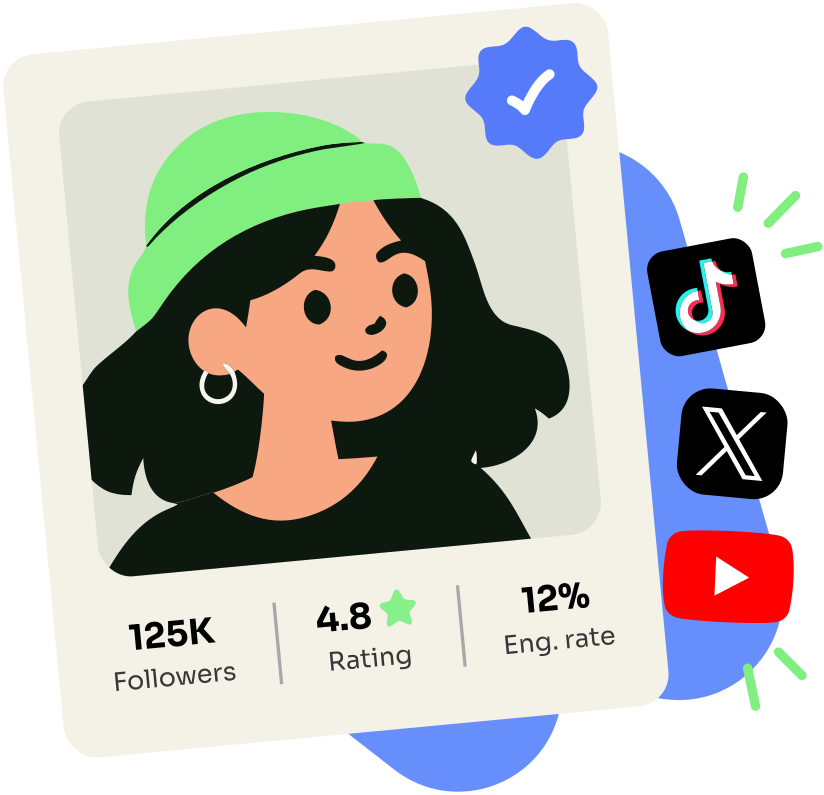
See who's talking
Open the profile behind any mention on TikTok, Instagram or YouTube, with follower and engagement counts, on the same key.
What does it cost to track 10 keywords?
On Social Fetch, 10 keywords on X, Reddit, TikTok and Instagram, checked hourly, is $79 a month. Vendr's median Brandwatch contract is $50,000 a year, on an annual term.
Social Fetch
from$1.35
per 1,000 keyword searches
- No card to start
- Credits never expire
- Failed lookups aren't billed
Brandwatch
$50,000
a year: Vendr's median Brandwatch contract across 40 purchases (Feb 2026). No public price list.
10 keywords × 4 networks, hourly
- Social Fetch
- $79/mo on Growth (28,800 of 50,000 credits)
- Brandwatch
- Not sold per check; the annual contract (Vendr median about $4,170 a month)
Same keywords every 15 minutes
- Social Fetch
- $225/mo on Scale (115,200 of 150,000 credits)
- Brandwatch
- Same contract; searches past about 2,500 mentions a day are sampled
Typical yearly spend
- Social Fetch
- $948 for the hourly scenario
- Brandwatch
- Vendr median $50,000 (range $19,542 to $81,200)
Contract terms
- Social Fetch
- Pay as you go, or a monthly plan; pay-as-you-go credits never expire
- Brandwatch
- Annual as standard; 2–3 year terms often bring 15–25% off (Vendr)
Setup and onboarding fees
- Social Fetch
- None
- Brandwatch
- A few thousand dollars, up to 10–15% of contract value for complex setups (Vendr)
| Scenario | Social Fetch | Brandwatch |
|---|---|---|
| 10 keywords × 4 networks, hourly | $79/mo on Growth (28,800 of 50,000 credits) | Not sold per check; the annual contract (Vendr median about $4,170 a month) |
| Same keywords every 15 minutes | $225/mo on Scale (115,200 of 150,000 credits) | Same contract; searches past about 2,500 mentions a day are sampled |
| Typical yearly spend | $948 for the hourly scenario | Vendr median $50,000 (range $19,542 to $81,200) |
| Contract terms | Pay as you go, or a monthly plan; pay-as-you-go credits never expire | Annual as standard; 2–3 year terms often bring 15–25% off (Vendr) |
| Setup and onboarding fees | None | A few thousand dollars, up to 10–15% of contract value for complex setups (Vendr) |
Brandwatch prices checked 25 September 2026. How we priced this, with sources
Pricing
Social data, priced simply.
Start with 100 free credits. Monthly plans give you predictable volume and lower per-request rates.
Starter
1,000credits
$14.00 per 1k · $0.0140 per request
- Prove one workflow before you buy more
- All 25 platforms on one API key
Growth
25,000credits
$2.36 per 1k · $0.00236 per request
- For a project or one-off batch job
- Better per-credit rate than the Starter pack
Scale
230,000credits
$1.64 per 1k · $0.00164 per request
- For a large one-time job
- Best pack rate of the three — includes bonus credits
Need 1M+ credits, invoicing, or volume rates? Talk to us
Trust signals
DevHunt
Product Hunt
Uneed
Social Fetch vs Brandwatch, side by side.
How each product expects you to integrate, what you're billed for, and which capabilities come as standard.
What you buy
- Social Fetch
- Search and monitor endpoints that return JSON
- Brandwatch
- Consumer Research and Listen dashboards on an annual contract
API request limit
- Social Fetch
- No enforced RPS cap on paid routes
- Brandwatch
- 30 requests per 10 minutes per client
Post text through the API
- Social Fetch
- Full text, author and metrics in every search response
- Brandwatch
- X text stripped, news cut to a 256-character snippet, no LinkedIn text
TikTok
- Social Fetch
- Keyword search across public videos with
GET /v1/tiktok/search - Brandwatch
- TikTok Mentions API: posts and comments that @mention your handle
Archive and dashboards
- Social Fetch
- None built in; store the JSON and chart it in your own BI
- Brandwatch
- News, blogs and forums back to 2010, built-in dashboards and Iris AI
| Row | Social Fetch | Brandwatch |
|---|---|---|
| What you buy | Search and monitor endpoints that return JSON | Consumer Research and Listen dashboards on an annual contract |
| API request limit | No enforced RPS cap on paid routes | 30 requests per 10 minutes per client |
| Post text through the API | Full text, author and metrics in every search response | X text stripped, news cut to a 256-character snippet, no LinkedIn text |
| TikTok | Keyword search across public videos with GET /v1/tiktok/search | TikTok Mentions API: posts and comments that @mention your handle |
| Archive and dashboards | None built in; store the JSON and chart it in your own BI | News, blogs and forums back to 2010, built-in dashboards and Iris AI |
| Capability | Social Fetch | Brandwatch |
|---|---|---|
| Published self-serve pricing | ||
| No annual contract or sales call to start | ||
| Full post text and metrics as JSON in every response | ||
| Keyword search on TikTok, Instagram, X, Reddit, YouTube, LinkedIn and Threads | ||
| Scheduled monitors with signed webhooks | ||
| API access without an enterprise plan | ||
| Hosted MCP server for AI agents | ||
| Built-in sentiment and dashboards | ||
| Historical mention archive | ||
| Print, TV and radio coverage |
Customers
Teams building on Social Fetch.
“Our TikTok and Instagram scrapers broke constantly. Social Fetch took us off that rotation — we ship product again.”
“Transcripts at volume from one endpoint. No broken scrapers for our small team to maintain.”
“Live profile data on every request. We never flag accounts from a stale cache.”
“Heavy concurrent load, no rate limits to negotiate. The rare API I haven't wrapped in retries.”
Which one should you pick?
If the Brandwatch list sounds like you, Brandwatch is probably the better buy — and that's fine.
Pick Social Fetch if…
- You need the posts as JSON, including X and LinkedIn text, in your own database or model
- You want TikTok keyword search across public videos, not only @mentions of your handle
- The budget is $79 to $225 a month, not a $50,000 annual contract
- You want data this week, with no demo, quote or seat licences
Pick Brandwatch if…
- You need history: news, blogs and forums back to 2010, and historical X posts
- Your analysis has to sit on the official X firehose rather than live search
- Analysts want Iris AI, sentiment and dashboards in one no-code workspace
- You track TV, radio or podcasts, which Brandwatch sells as premium data
Social Fetch vs Brandwatch: common questions
Migration, billing surprises, and what changes when you add a second platform.
How much does Brandwatch cost?
Brandwatch doesn't publish prices. Vendr's marketplace data (February 2026) puts the median contract at $50,000 a year, with a range of $19,542 to $81,200 across 40 purchases. Contracts are usually annual; 2 to 3 year terms often come with 15 to 25% off, and onboarding fees can add a few thousand dollars or more. Social Fetch prices are public: from $1.35 per 1,000 requests, and the standard 10-keyword hourly scenario fits the $79-a-month Growth plan.
Does Brandwatch have an API, and what are the rate limits?
Yes. The Consumer Research API lets you create queries and retrieve mentions, with a default limit of 30 requests every 10 minutes per client. Paging with page and pageSize stops at 10,000 mentions, then you need cursors. Its data-restrictions docs say X mentions come back without full text, news is a 256-character snippet and LinkedIn has no text. Social Fetch has no enforced RPS cap on paid routes and returns full post text, for example from GET /v1/twitter/search.
Can Brandwatch track TikTok?
Brandwatch's TikTok integration, announced on 3 March 2025, uses TikTok's Mentions API, which returns posts and comments that @mention your brand handle. To find videos that mention your brand without tagging it, use GET /v1/tiktok/search, which searches public TikTok videos by keyword and can run as a monitor with a webhook.
Is Social Fetch a Brandwatch alternative?
Yes, for teams that want the social data itself: keyword search on TikTok, X, Reddit, Instagram, YouTube, LinkedIn and Threads as full-text JSON, Monitors that push new posts to a signed webhook, and an MCP server for AI agents. It costs a fraction of a typical Brandwatch contract and needs no sales call. It doesn't replace Brandwatch's archive back to 2010, its dashboards or its broadcast coverage; if those are what you use, keep Brandwatch for them.
Can Social Fetch do sentiment analysis?
Not built in. Social Fetch returns the full text and metrics, and you score them with your own model. Send monitor webhooks or search results to Claude or GPT through the API or the MCP server, and define sentiment, topics and relevance for your brand in the prompt.
How do I migrate from Brandwatch to Social Fetch?
Take each Brandwatch query's core keywords and create one monitor per source with POST /v1/monitors: TikTok search, X search, Reddit search or an Instagram hashtag. Point them at one webhook endpoint and move the Boolean exclusions into a filter or model prompt on your side. Add ?dryRun=true to see each monitor's monthly credits first. Run both in parallel for a week and compare what arrives. The Monitors docs cover the setup.
Does Social Fetch keep a historical archive like Brandwatch?
No. Social Fetch searches live and returns what each platform shows now, and search filters such as datePosted on GET /v1/tiktok/search reach back as far as the platform's own search does. For a mention archive going back years, Brandwatch is the better fit. Store Social Fetch results in your own warehouse from day one and that becomes your archive.
The detailed Social Fetch vs Brandwatch comparisonHow Brandwatch works, where the costs come from, and when to keep it.
The short version
Brandwatch rents you a listening dashboard on an annual contract; Vendr's median Brandwatch deal is $50,000 a year. Its own API docs limit what you can take out: 30 requests per 10 minutes, X mentions without their text, news cut to a 256-character snippet and LinkedIn with no text at all. Social Fetch sells the data layer directly. Search endpoints across 25 platforms return the full post, author and metrics as JSON, Monitors push new matches to your webhook, and you run sentiment or summaries with your own model. Prices are public and start at $1.35 per 1,000 requests.
Brandwatch sells a dashboard on an annual contract
Brandwatch is a listening and consumer research suite. Analysts build Boolean queries, then read the results in dashboards with sentiment, Iris AI and reports. It has no public price list. Vendr's data puts the median contract at $50,000 a year across 40 purchases, with a range of $19,542 to $81,200 (February 2026). Annual terms are standard, 2 to 3 year terms often come with 15 to 25% off, and Vendr reports onboarding fees from a few thousand dollars up to 10 to 15% of contract value for complex setups.
That price buys the whole workspace: the archive, the dashboards, the analyst tools and the seats. If what your team needs is the posts themselves, flowing into a warehouse, a Slack channel or a model, most of that spend goes on screens nobody opens.
Comparing listening suites more broadly? See Social Fetch vs Meltwater.
What the Brandwatch API lets you take out
Brandwatch's Consumer Research API allows 30 requests every 10 minutes per client, on a rolling window, and returns HTTP 429 past that. You create a query with POST /projects/{projectId}/queries, then page mentions from GET /projects/{projectId}/data/mentions in pages of up to 5,000. Past 10,000 mentions you switch to cursor paging.
The bigger limit is what comes back. Brandwatch's data-restrictions page says X mentions lose their full text and most fields when you retrieve them through the API. Online news is a 256-character snippet. LinkedIn posts and comments come with no snippet or full text. You can see those posts in the dashboard, but you can't take the text out to run your own analysis.
Social Fetch returns the full post in every response. GET /v1/twitter/search includes the tweet text, author and metrics; GET /v1/reddit/search includes the title and body text; GET /v1/linkedin/posts/search returns public LinkedIn posts. You store the JSON and it's yours.
TikTok coverage and mention sampling
Brandwatch expanded its TikTok partnership on 3 March 2025 with an integration built on TikTok's Mentions API, which returns posts and comments that @mention a brand's handle. Videos that talk about your product without tagging you are outside that feed.
GET /v1/tiktok/search searches public TikTok videos by keyword, with filters for upload date, sort order and region, and returns each video's caption, author and stats. Pair it with GET /v1/tiktok/videos/transcript when the brand is said out loud but never written.
Volume is the other limit. Brandwatch's Listen, in its social media management product, typically indexes up to 2,500 mentions per search per day. When a search passes that on any five days in a month, Listen samples it: if the fifth-busiest day reached 10,000 mentions, 75% of mentions are dropped. Social Fetch has no daily mention cap. Each monitor check returns one page of the newest results, so a busy keyword can need a shorter interval to catch every post.
Rebuild the listening loop on Social Fetch
Monitors run the poll-and-diff loop for you and POST a signed webhook when something new appears. They watch TikTok profile videos, video search and top search; X profile tweets and search; Instagram posts, reels, tagged posts and hashtags; and Reddit subreddit posts, subreddit search and site-wide search. Everything else, such as GET /v1/youtube/search or GET /v1/threads/search, is on-demand search that you schedule yourself.
Social Fetch doesn't ship sentiment or dashboards. Send the JSON to Claude or GPT through the API or the MCP server to score sentiment, tag topics or write the weekly summary, with a prompt you control. The brand monitoring recipe walks through the setup, and Billing for monitors shows how to preview a monitor's cost with dryRun before you create it.
Bottom line: Rent the dashboard, or own the data
Brandwatch is the right buy when the deliverable is an insights programme: a 2010-onward archive, the official X firehose, Iris AI and broadcast coverage in one workspace, for a median of $50,000 a year. When the deliverable is the data, Social Fetch is cheaper for the same keyword watch ($79 a month for 10 keywords on four platforms, checked hourly), faster to first data, and returns the full text that Brandwatch's API strips from X and LinkedIn. It also searches public TikTok videos by keyword, beyond @mentions of your handle. Start with 100 free credits and a TikTok search in the playground.
Methodology and sourcesHow we priced each scenario, and where every Brandwatch figure comes from. Checked 25 September 2026.
How we priced it
Track 10 keywords on X, Reddit, TikTok and Instagram, checked hourly: 10 × 4 × 24 × 30 = 28,800 checks a month. On Social Fetch each check is one call to GET /v1/twitter/search, GET /v1/reddit/search, GET /v1/tiktok/search or GET /v2/instagram/hashtags/{hashtag}/media at 1 credit (Instagram is watched by hashtag). That is 40 monitors and 28,800 credits a month, which fits the Growth plan at $79 a month (50,000 credits, up to 100 monitors). Checking every 15 minutes uses 115,200 credits, which fits the Scale plan at $225 a month (150,000 credits). Brandwatch doesn't publish prices or sell per check, so we compare against Vendr's median Brandwatch contract of $50,000 a year (about $4,170 a month) from 40 purchases, with a range of $19,542 to $81,200 (February 2026).
Sources
Sources, checked 25 September 2026. Brandwatch prices, contract terms and onboarding fees: Vendr's Brandwatch page (third-party estimate: median $50,000 a year, range $19,542 to $81,200, 40 purchases, updated February 2026). API rate limit: Brandwatch's rate-limiting docs. Text limits on X, news and LinkedIn: its data-restrictions docs. Paging: its mentions docs. Mention sampling: the help article Limits on Listen searches and mentions (updated 10 December 2025; the cap can vary by contract). TikTok scope: Brandwatch's TikTok announcement (3 March 2025). Archive and broadcast coverage: Brandwatch's data networks page. Social Fetch's lowest rate is the Scale plan billed annually ($2,430 for 1.8M credits, about $1.35 per 1,000); scenario prices are the monthly list prices of Growth ($79, 50,000 credits) and Scale ($225, 150,000 credits).
Brandwatch is a trademark of its owner. Social Fetch is not affiliated with, endorsed by or sponsored by Brandwatch. Details about Brandwatch come from public sources checked on 25 September 2026.
See the response for yourself.
Run a real lookup in the playground before you migrate anything. 100 free credits, no card, and the JSON comes back in the same request.
No credit cardSign up in 30 seconds withGoogleGitHub