

Social Fetch vs ScraperAPI
ScraperAPI is a scraping infrastructure API — send a URL, get HTML (or parsed JSON helpers) through rotating proxies, JS rendering, and anti-bot handling. Social Fetch is a social data API — send a handle, get normalized profile fields. LinkedIn on ScraperAPI can cost 30 credits per request; on Social Fetch it is a first-class route at flat social pricing.
- What returns
- Structured social JSONHTML (plus optional parsing) via proxies
- Pricing entry
- 100 free credits; $14 Starter pack (1,000 credits, one-time, never expire)Hobby $49/mo for 100,000 credits
- LinkedIn request cost
- Standard social credit (typically 1)30 credits per their domain guide
Teams running monitoring, research, and enrichment pipelines


Why Social Fetch
Why teams switch from ScraperAPI.
What changes when your social lookups move to one REST API.
One API for 25 platforms
TikTok, Instagram, YouTube, LinkedIn, Reddit, X and more behind one key and one schema — no separate ScraperAPI setup per network.
Pricing you can reason about
One completed lookup, one price. Failed lookups aren't billed, so you know how far a balance goes.
JSON in the same request
Fetched live when you ask and returned in the response — ~3.2s on average, no job to poll.
No scraper maintenance
We handle proxies, browser changes, and platform breakages.
Built for production jobs
Run concurrent workloads with explicit statuses and request IDs.
Pay as you go, or save monthly
Start with 100 free credits and no subscription. Pay-as-you-go credits never expire; running lookups every month? A monthly plan gets you lower per-credit rates.
What teams build with Social Fetch
Monitoring, enrichment, research and content workflows — the jobs teams run on ScraperAPI, as plain API calls.
Monitor brands and competitors
Watch accounts on a schedule and get a signed webhook when something new posts.
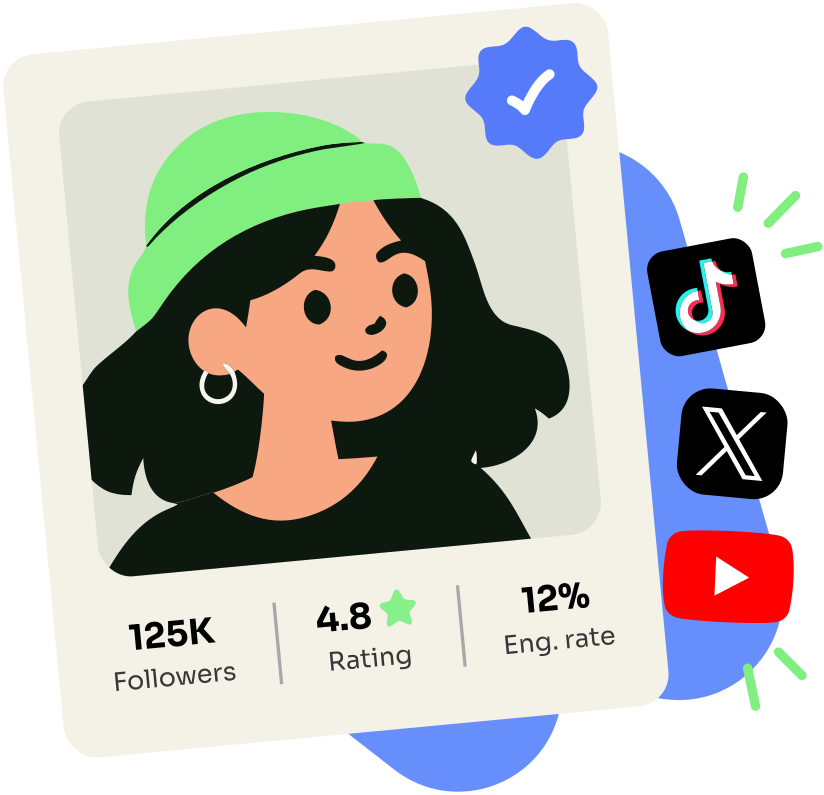
Find and vet creators
Check reach and engagement before you reach out.
Turn video into searchable text
Transcribe and index video and audio content so you can find the exact moment you need.
Track public communities
Follow the subreddits, groups, and channels where your audience talks.
Domain multipliers vs flat social credits
ScraperAPI Hobby $49/mo (100k credits). Standard page 1 credit; LinkedIn 30, Google/Bing 25, anti-bot +10. Credits reset monthly. Social Fetch: flat social credits at $1.64/1k on non-expiring packs.
1,000 LinkedIn profile pages (raw HTML path)
- Social Fetch
- ~$1.64 as API lookups (structured)
- ScraperAPI
- 30,000 credits → burns a large share of Hobby
1,000 generic easy pages
- Social Fetch
- Use a scrape vendor — not our job
- ScraperAPI
- 1,000 credits on Hobby
Monthly reset
- Social Fetch
- No on PAYG packs
- ScraperAPI
- Yes — unused credits expire each cycle
JS rendering / proxies
- Social Fetch
- Handled on our social routes
- ScraperAPI
- Included — that is the product
Free trial
- Social Fetch
- 100 credits, no card
- ScraperAPI
- 7-day trial with 5,000 credits (no card)
| Scenario | Social Fetch | ScraperAPI |
|---|---|---|
| 1,000 LinkedIn profile pages (raw HTML path) | ~$1.64 as API lookups (structured) | 30,000 credits → burns a large share of Hobby |
| 1,000 generic easy pages | Use a scrape vendor — not our job | 1,000 credits on Hobby |
| Monthly reset | No on PAYG packs | Yes — unused credits expire each cycle |
| JS rendering / proxies | Handled on our social routes | Included — that is the product |
| Free trial | 100 credits, no card | 7-day trial with 5,000 credits (no card) |
ScraperAPI prices checked 21 July 2026. How we priced this, with sources
Pricing
Social data, priced simply.
Start with 100 free credits. Monthly plans give you predictable volume and lower per-request rates.
Starter
1,000credits
$14.00 per 1k · $0.0140 per request
- Prove one workflow before you buy more
- All 25 platforms on one API key
Growth
25,000credits
$2.36 per 1k · $0.00236 per request
- For a project or one-off batch job
- Better per-credit rate than the Starter pack
Scale
230,000credits
$1.64 per 1k · $0.00164 per request
- For a large one-time job
- Best pack rate of the three — includes bonus credits
Need 1M+ credits, invoicing, or volume rates? Talk to us
Trust signals
DevHunt
Product Hunt
Uneed
Social Fetch vs ScraperAPI, side by side.
How each product expects you to integrate, what you're billed for, and which capabilities come as standard.
What returns
- Social Fetch
- Structured social JSON
- ScraperAPI
- HTML (plus optional parsing) via proxies
Pricing entry
- Social Fetch
- 100 free credits; $14 Starter pack (1,000 credits, one-time, never expire)
- ScraperAPI
- Hobby $49/mo for 100,000 credits
LinkedIn request cost
- Social Fetch
- Standard social credit (typically 1)
- ScraperAPI
- 30 credits per their domain guide
Google / Bing SERP
- Social Fetch
- Limited Google utilities — not a SERP farm
- ScraperAPI
- 25 credits per request (domain guide)
Who maintains social parsers
- Social Fetch
- Social Fetch
- ScraperAPI
- You (or their structured add-ons where available)
Social catalog
- Social Fetch
- 264 ops / 25 platforms
- ScraperAPI
- Any URL — credits vary by domain difficulty
| Row | Social Fetch | ScraperAPI |
|---|---|---|
| What returns | Structured social JSON | HTML (plus optional parsing) via proxies |
| Pricing entry | 100 free credits; $14 Starter pack (1,000 credits, one-time, never expire) | Hobby $49/mo for 100,000 credits |
| LinkedIn request cost | Standard social credit (typically 1) | 30 credits per their domain guide |
| Google / Bing SERP | Limited Google utilities — not a SERP farm | 25 credits per request (domain guide) |
| Who maintains social parsers | Social Fetch | You (or their structured add-ons where available) |
| Social catalog | 264 ops / 25 platforms | Any URL — credits vary by domain difficulty |
| Capability | Social Fetch | ScraperAPI |
|---|---|---|
| Synchronous REST JSON (no actor run polling) | ||
| One API key for all platforms | ||
| Unified schema across platforms | ||
| Public OpenAPI specification | ||
| Official TypeScript SDK | ||
| Interactive API playground | ||
| TikTok, Instagram, YouTube, LinkedIn, Facebook, Reddit, X in one vendor | ||
| Pay-as-you-go without required monthly subscription | ||
| PAYG credits never expire | ||
| Web fetch (markdown/HTML) in same product | ||
| Scheduled account / feed monitors | ||
| Signed webhooks when watched accounts post |
Customers
Teams building on Social Fetch.
“Our TikTok and Instagram scrapers broke constantly. Social Fetch took us off that rotation — we ship product again.”
“Transcripts at volume from one endpoint. No broken scrapers for our small team to maintain.”
“Live profile data on every request. We never flag accounts from a stale cache.”
“Heavy concurrent load, no rate limits to negotiate. The rare API I haven't wrapped in retries.”
Which one should you pick?
If the ScraperAPI list sounds like you, ScraperAPI is probably the better buy — and that's fine.
Pick Social Fetch if…
- Structured social profiles and posts without HTML parsing
- LinkedIn/social workloads where domain multipliers hurt
- PAYG credits that never expire for bursty social traffic
- One normalized envelope across social networks
Pick ScraperAPI if…
- General web scraping across arbitrary domains
- SERP and e-commerce extraction with proxy/anti-bot needs
- You want HTML and will maintain parsers yourself
Social Fetch vs ScraperAPI: common questions
Migration, billing surprises, and what changes when you add a second platform.
Can ScraperAPI scrape Instagram for me?
It can fetch URLs through proxies. You still parse HTML and absorb domain/anti-bot credit costs. Social Fetch returns structured Instagram resources on maintained routes.
Why is LinkedIn 30 credits on ScraperAPI?
Harder anti-bot domains cost more credits on their price list. That is expected for a general scrape API. A social API absorbs that complexity into a flat social credit where possible.
Do ScraperAPI credits roll over?
No — monthly plan credits reset. Social Fetch PAYG packs never expire.
Which should startups pick first?
If the feature is social data in the product, Social Fetch. If the feature is scraping many non-social sites, ScraperAPI. Startups often need both later; start with the dominant URL class.
The detailed Social Fetch vs ScraperAPI comparisonHow ScraperAPI works, where the costs come from, and when to keep it.
Proxy API vs social API
ScraperAPI sells access to scraping infrastructure: IP rotation, rendering, retries, geotargeting. You bring the URL and the parser. That is the right purchase for e-commerce pages, SERPs, and long-tail sites where no vertical API exists.
Social Fetch sells the parsed social object. Proxies and rendering still happen — on our side — but your contract is the OpenAPI schema, not the HTML. When Instagram changes markup, we patch extractors; your followerCount field stays put.
Using ScraperAPI as a social API means you own breakage. Using Social Fetch as a general web scraper means you bought the wrong catalog.
LinkedIn at 30 credits is the tell
ScraperAPI is honest about hard domains costing more. LinkedIn at 30 credits means 3,333 LinkedIn fetches exhaust a 100,000-credit Hobby plan before you count failures and renders. For a product that enriches LinkedIn companies all day, that metering pushes you up the plan ladder quickly.
Social Fetch prices LinkedIn as part of the social catalog at the same credit philosophy as TikTok for standard routes. You are paying for the social operation, not for how angry LinkedIn's bot defenses were that hour.
Split by URL type
Keep ScraperAPI for Amazon, Google results, and random marketing sites. Keep Social Fetch for TikTok, Instagram, YouTube, LinkedIn, Facebook, Reddit, and the rest of our 25-platform catalog. When Instagram markup changes, ScraperAPI still returns HTML you must re-parse; we patch extractors so followerCount stays put. Many data teams already run both; the mistake is forcing one vendor across both URL classes.
Bottom line: Scraping infrastructure vs social data product
ScraperAPI is a strong proxy scrape API. Social Fetch is a strong social data API. Domain credit multipliers make ScraperAPI expensive precisely where social platforms are hardest — which is where a vertical social API earns its keep. Use ScraperAPI for the open web; use Social Fetch when the resource is a social entity.
Methodology and sourcesHow we priced each scenario, and where every ScraperAPI figure comes from. Checked 21 July 2026.
Sources
ScraperAPI pricing from scraperapi.com/pricing (July 2026). Domain credit costs from their FAQ (LinkedIn 30, Google/Bing 25, Amazon 5, anti-bot +10). Always verify with their Domain Cost Estimator for your URLs.
ScraperAPI is a trademark of its owner. Social Fetch is not affiliated with, endorsed by or sponsored by ScraperAPI. Details about ScraperAPI come from public sources checked on 21 July 2026.
See the response for yourself.
Run a real lookup in the playground before you migrate anything. 100 free credits, no card, and the JSON comes back in the same request.
No credit cardSign up in 30 seconds withGoogleGitHub