
Facebook scraper API. Every public page and group.
Posts and comments from public pages and groups, plus Marketplace listings and the Ad Library, as JSON in one request. No Meta app and no page token.
- No Meta app or tokens
- Marketplace and Ad Library
- Groups and comment threads
- Failed lookups aren't charged
Teams running monitoring, research, and enrichment pipelines


Why Social Fetch
We run the Facebook scrapers. You build the product.
Live Facebook data as JSON — proxies, platform changes and consistent output handled for you.
Facebook, plus every other network
One key and one response envelope for Facebook and 24 more platforms — profiles, posts, search, comments and transcripts.
Pricing you can reason about
One request, one credit. Know how far your balance will go before you run your next batch.
Live data on every request
Fetch public data when you ask for it — not from a shared cache.
No scraper maintenance
We handle proxies, browser changes, and platform breakages.
Built for production jobs
Run concurrent workloads with explicit statuses and request IDs.
Regular jobs. Better rates.
Running lookups every month? Get lower per-credit rates with a monthly plan. For occasional projects, choose pay as you go.
What Facebook data can you get?
21 endpoints, one API key. Every response comes back as live JSON in the same envelope.
Profiles & channels
Look up a Facebook account by handle or URL — bio, counts and metadata.
Lists & graphs
Page through an account's posts, videos, followers and more.
Content
Fetch a single post or video by URL, with metrics and media.
Search & discovery
Search Facebook by keyword, hashtag or trend.
Comments
Pull comment threads and replies for any public post.
Transcripts
Plain-text transcripts with timestamps for video content.
Marketplace
Marketplace listings and search.
Ads
Ads from the public ad library, by advertiser or keyword.
Other
More Facebook routes on the same key.
Browse all 21 Facebook endpoints
Profiles & channels
Lists & graphs
Content
Search & discovery
Comments
Transcripts
Marketplace
Ads
Other
What teams build with Facebook data
Monitoring, enrichment, research and content workflows on Facebook data — the same API as every other platform.
Monitor brands and competitors
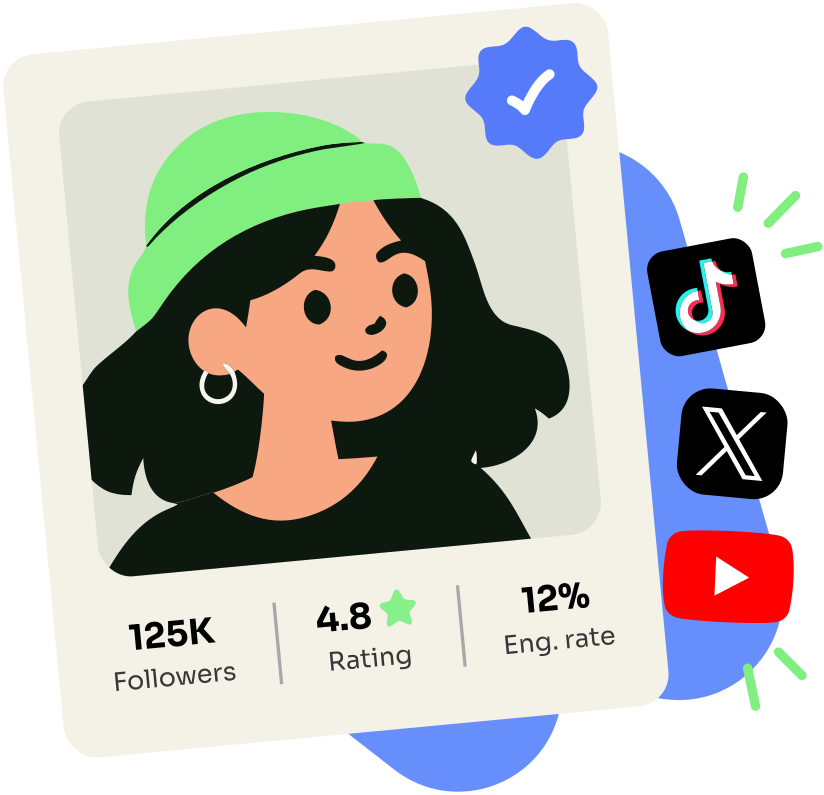
Find and vet creators
Check reach and engagement before you reach out.
Turn video into searchable text
Transcribe and index video and audio content so you can find the exact moment you need.
Track public communities
Follow the subreddits, groups, and channels where your audience talks.
How it works
Your first request in three steps.
Use TypeScript or your automation tool of choice.
Sources
+ 19 more platforms
One request
GET/v1/tiktok/profiles/
x-api-key: sk_live_••••••••
Same JSON shape
{
  "data": {
    "lookupStatus": "found",
    "profile": {
      "platform": "tiktok",
      "handle": "charlidamelio",
      "displayName": "charli d’amelio",
      "verified": true
    },
    "metrics": {
      "followers": 160263648
    }
  }
}
Step 1
Create your free account
Get an API key with 100 requests included.
Step 2
Choose an endpoint
Pass a username, URL, keyword, or post ID.
Step 3
Get clean JSON
Use the response immediately or send it into your pipeline.
Works with your stack
Code, automate, or connect your AI.
 TypeScript
 n8n
n8n- Make
- Apify
- MCP
- AI clients
Pricing
Social data, priced simply.
Start with 100 free credits. Monthly plans give you predictable volume and lower per-request rates.
Starter
18,000credits
$1.61 per 1k · $0.00161 per request
- Top up from $1.61 / 1k if you run out
- Up to 25 monitors
Growth
50,000credits
$1.58 per 1k · $0.00158 per request
- Top up from $1.58 / 1k if you run out
- 5 team seats
- Up to 100 monitors
Scale
150,000credits
$1.50 per 1k · $0.00150 per request
- Top up from $1.50 / 1k if you run out
- 25 team seats
- Up to 250 monitors
- Cancel anytime
- 30-day money-back guarantee
- Price locked while you stay
Need 1M+ credits, invoicing, or volume rates? Talk to us
Trust signals
DevHunt
Product Hunt
Uneed
Customers
Teams building on Social Fetch.
“Our TikTok and Instagram scrapers broke constantly. Social Fetch took us off that rotation — we ship product again.”
“Transcripts at volume from one endpoint. No broken scrapers for our small team to maintain.”
“Live profile data on every request. We never flag accounts from a stale cache.”
“Heavy concurrent load, no rate limits to negotiate. The rare API I haven't wrapped in retries.”
Facebook API: common questions
Is there a Facebook scraper API that doesn't need Graph API access?
Yes. Social Fetch's Facebook routes read public pages, posts, groups, Marketplace, and Ad Library data over REST with a Social Fetch API key. You never connect a Meta app, request a page access token, or need admin rights on the Page, group, or ad account you're looking up.
How do I look up a Facebook page or profile by URL?
Call GET /v1/facebook/profiles with a public Facebook url query param. Check data.lookupStatus (found, private, or not_found) before reading data.profile, which can include profileType (person or business), likes, followers, contact fields, and business hours when includeBusinessHours=true is set.
How do I list posts, Reels, photos, or events for a Facebook Page?
Page the feed with GET /v1/facebook/profiles/posts, the Reels tab with GET /v1/facebook/profiles/reels, the Photos tab with GET /v1/facebook/profiles/photos, or the Events tab with GET /v1/facebook/profiles/events. Each takes a public url (posts also accepts pageId) and pages with data.page.nextCursor while hasMore is true. Profile events is a Page's own calendar, not city-wide explore or event search by name.
Can I get comments and a transcript on the same post call?
Yes. GET /v1/facebook/posts accepts includeComments=true for a sample of top-level comments and includeTranscript=true for plain-text speech, alongside the caption, author, and media fields. For a full paginated thread instead of a sample, call GET /v1/facebook/posts/comments and, for nested replies, GET /v1/facebook/posts/comments/replies with a comment's repliesCursor.
Do you support Facebook groups?
Public groups only. GET /v1/facebook/groups returns the About-page profile (name, privacy, member counts, admins, rules) from a group URL or numeric groupId. GET /v1/facebook/groups/posts pages the feed; use sortBy=chronologicalListings for Buy/Sell marketplace groups. Private groups are not accessible — there is no public lookup path for them.
Does Facebook Marketplace search work via API?
Yes, in three steps: resolve a city or place name to coordinates with GET /v1/facebook/marketplace/locations/search, search listings by keyword near that lat/lng with GET /v1/facebook/marketplace/search (filterable by price, radius, condition, and delivery method), and fetch one known listing by itemId or url with GET /v1/facebook/marketplace/items.
Can I access Facebook Ad Library via API?
Yes — four routes under the Facebook tag. GET /v1/facebook/ad-library/ads/search finds ads by keyword with country, status, media-type, and date filters. GET /v1/facebook/ad-library/ads fetches one ad by archive id or URL, with an optional video transcript. GET /v1/facebook/ad-library/companies/search turns a brand name into a pageId, and GET /v1/facebook/ad-library/companies/ads lists every ad for that page.
How much does the Facebook API cost?
Pricing is documented on the operation in the API registry (shown on this page). Confirm on every response with meta.creditsCharged — that field is the billing source of truth. Each paginated page is a separate billed request.
Facebook Graph API vs Social Fetch — what's the difference?
Graph API and Marketing API manage Pages and ad accounts you control — posting, Insights, campaign reporting — and require app review plus access tokens. Social Fetch is public-data enrichment: URL or search query in, structured JSON out, one Social Fetch API key.
Can I pull Facebook Reels and their transcripts?
Yes. List a Page's Reels with GET /v1/facebook/profiles/reels, then hydrate one Reel with GET /v1/facebook/posts?url=…&includeTranscript=true, or call GET /v1/facebook/posts/transcript for transcript text on its own. A found lookup does not guarantee non-null transcript text — some clips have no detectable speech.
Is scraping Facebook data legal?
Social Fetch returns publicly visible pages, posts, groups, Marketplace listings, and Ad Library entries — the same data a signed-out browser can see. You're responsible for how you use it under Meta's terms, applicable law, and your own compliance review. We don't give legal advice.
The Facebook API in detailHow the Facebook routes work, what they cost, and how they differ from the official API.
Why teams use Social Fetch for Facebook
Facebook still has surfaces Instagram and TikTok don't: business Pages, public groups, Marketplace, and Meta Ad Library. Social Fetch's Facebook tag is sixteen REST GETs behind one API key, all returning { data, meta }.
GET /v1/facebook/profiles resolves a public page or profile URL to a card with profileType, likes, followers, and business fields. GET /v1/facebook/profiles/posts, .../reels, .../photos, and .../events page a Page's feed, Reels tab, Photos tab, and Events tab with cursor pagination. GET /v1/facebook/posts hydrates a single post or Reel permalink, with optional includeComments and includeTranscript; GET /v1/facebook/posts/comments and .../comments/replies page the full thread; GET /v1/facebook/posts/transcript returns spoken text on its own. GET /v1/facebook/groups returns a public group's About-page profile (privacy, members, admins, rules) by group URL or numeric group ID. GET /v1/facebook/groups/posts pages that group's feed by URL with sortBy options for Buy/Sell groups. Three Marketplace routes cover city-to-coordinates, keyword search near lat/lng, and single-listing lookup. Four Ad Library routes cover keyword ad search, single-ad detail, advertiser name-to-page-id search, and full ad listings for one page.
Every response uses data.lookupStatus (found / not_found, and private on profiles). List routes add data.page.hasMore and data.page.nextCursor. Every call reports meta.requestId and meta.creditsCharged.
How to call the Facebook API
1. Create an API key
Sign up at Social Fetch and copy a key (
sfk_…). New accounts get 100 free credits — enough to resolve a Page profile, page a few posts, and run one Ad Library search against live data.2. Call a Facebook route
Start with
GET /v1/facebook/profiles?url=…for a Page or profile card, then move toprofiles/posts,profiles/reels,profiles/events,groups,groups/posts,marketplace/search, or the Ad Library routes depending on what you need. Sendx-api-keyon every request — the playground works for one-off checks, the TypeScript SDK or curl for production jobs.3. Read the shared envelope
Branch on
data.lookupStatusbefore writing rows —found,not_found, orprivate. Page list routes withdata.page.nextCursorwhilehasMoreis true. Logmeta.requestIdfor support and bill frommeta.creditsCharged, the source of truth for what a call cost.
What each Facebook route returns
- Public profile and Page cards — profileType, likes, followers, contact fields, business hours (
GET /v1/facebook/profiles). - Page and profile feed, Reels tab, Photos tab, and Events tab with cursor pagination (
profiles/posts,profiles/reels,profiles/photos,profiles/events). - Single post or Reel by permalink with optional inline comments and transcript (
GET /v1/facebook/posts). - Full comment threads and nested replies via cursor (
posts/comments,posts/comments/replies). - Standalone video transcript for posts and Reels (
GET /v1/facebook/posts/transcript). - Public group About-page profile by URL or group ID (
GET /v1/facebook/groups), and the group feed with asortBymode for Buy/Sell marketplace groups (GET /v1/facebook/groups/posts). - City events from a Facebook Events explore URL, with optional today / thisWeek / nextWeek filters (
GET /v1/facebook/events). - Marketplace: city/place to coordinates, keyword listing search near a lat/lng, and single-listing detail by item id or URL.
- Ad Library: keyword ad search, single-ad detail with optional transcript, advertiser name-to-pageId search, and full ad lists for one page.
How much does the Facebook API cost?
Every Facebook operation bills a flat 1 credit per completed lookup. Paginated routes (profiles/posts, profiles/reels, profiles/photos, profiles/events, groups/posts, posts/comments, posts/comments/replies, marketplace/search, and the three Ad Library list/search routes) bill each page separately. Credits never expire on pay-as-you-go packs. Always trust meta.creditsCharged.
Social Fetch vs the official Facebook API
Meta Graph API and Marketing API manage Pages and ad accounts you own — posting, Insights, campaigns. They require app review, access tokens, and (for Marketing API) an active ads account. Social Fetch looks up publicly visible pages, posts, groups, Marketplace listings, and Ad Library entries with a Social Fetch API key only — no Meta app review, no page token, no ads account.
 LinkedIn API
 Reddit API
 Threads API
 Bluesky API
 Pinterest API
 Rumble API
Pull your first Facebook data.
Run a live Facebook request in the playground. 100 free credits, no card, JSON back in seconds.
No credit cardSign up in 30 seconds withGoogleGitHub