

Social Fetch vs RapidAPI
RapidAPI is an app store for APIs: dozens of TikTok scrapers from different publishers, each with its own pricing, rate limits, response shape, and reliability record. Social Fetch is a first-party social data API with one key, one schema, one support team, and a requestId on every response.
- What you're buying
- Direct API from the team that built itAccess to third-party APIs via a marketplace
- Per 1,000 requests (typical scraper)
- $1.64 per 1,000 requests$2.50–$4.00+ per 1,000 (varies by API)
- 75k/mo multi-platform
- ~$124 one-time$79–139/mo recurring (3+ subscriptions)
Teams running monitoring, research, and enrichment pipelines


Why Social Fetch
Why teams switch from RapidAPI.
What changes when your social lookups move to one REST API.
One API for 25 platforms
TikTok, Instagram, YouTube, LinkedIn, Reddit, X and more behind one key and one schema — no separate RapidAPI setup per network.
Pricing you can reason about
One completed lookup, one price. Failed lookups aren't billed, so you know how far a balance goes.
JSON in the same request
Fetched live when you ask and returned in the response — ~3.2s on average, no job to poll.
No scraper maintenance
We handle proxies, browser changes, and platform breakages.
Built for production jobs
Run concurrent workloads with explicit statuses and request IDs.
Pay as you go, or save monthly
Start with 100 free credits and no subscription. Pay-as-you-go credits never expire; running lookups every month? A monthly plan gets you lower per-credit rates.
What teams build with Social Fetch
Monitoring, enrichment, research and content workflows — the jobs teams run on RapidAPI, as plain API calls.
Monitor brands and competitors
Watch accounts on a schedule and get a signed webhook when something new posts.
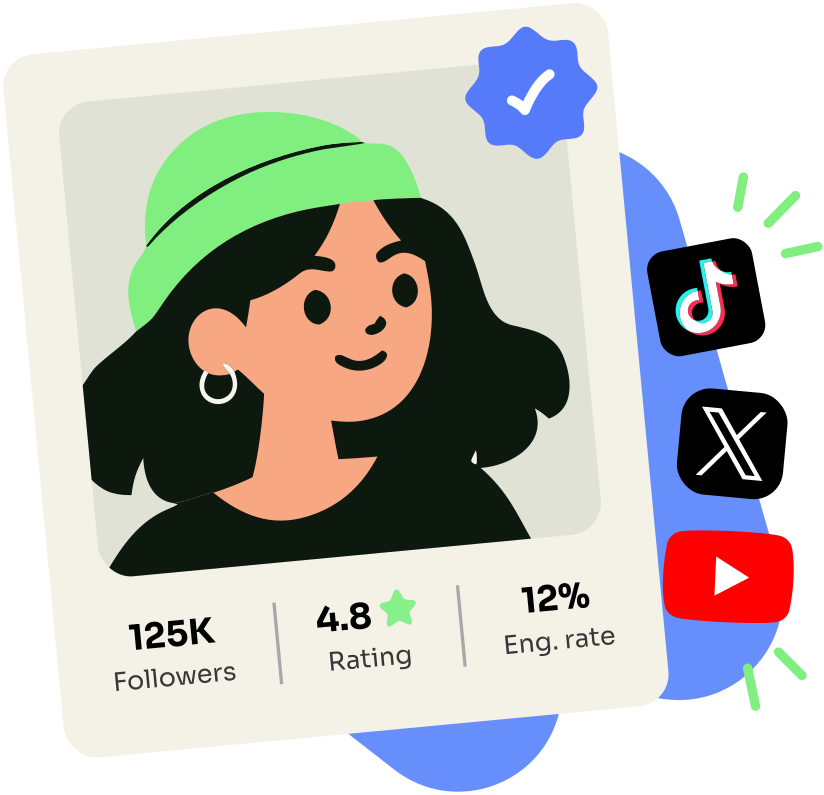
Find and vet creators
Check reach and engagement before you reach out.
Turn video into searchable text
Transcribe and index video and audio content so you can find the exact moment you need.
Track public communities
Follow the subreddits, groups, and channels where your audience talks.
The real cost of multi-platform social data on RapidAPI
TikTok Scraper7 Pro ($59/mo) looks cheap alone. Real products rarely stop at TikTok — Instagram and YouTube mean another listing each, with separate billing, rate limits, schemas, and publishers.
Per 1,000 requests (comparable scraper)
- Social Fetch
- $1.64 per 1,000
- RapidAPI
- $2.50–$4.00+ per 1,000 (marketplace APIs)
TikTok-only (75k/mo)
- Social Fetch
- ~$124 at the Scale pack rate
- RapidAPI
- $59/mo recurring (TikTok Scraper7 Pro only)
Adding 20k Instagram lookups
- Social Fetch
- Same balance, same API key
- RapidAPI
- +$10–30/mo for a separate API subscription
Adding 5k YouTube lookups
- Social Fetch
- Same balance, same API key
- RapidAPI
- +$10–50/mo for another API subscription
True multi-platform monthly cost
- Social Fetch
- ~$124 one-time
- RapidAPI
- $79–139/mo+ recurring (multiple subscriptions)
Engineering cost (often ignored)
- Social Fetch
- One client, one error handler, one schema mapper
- RapidAPI
- Three integrations, three mappers, three failure modes
| Scenario | Social Fetch | RapidAPI |
|---|---|---|
| Per 1,000 requests (comparable scraper) | $1.64 per 1,000 | $2.50–$4.00+ per 1,000 (marketplace APIs) |
| TikTok-only (75k/mo) | ~$124 at the Scale pack rate | $59/mo recurring (TikTok Scraper7 Pro only) |
| Adding 20k Instagram lookups | Same balance, same API key | +$10–30/mo for a separate API subscription |
| Adding 5k YouTube lookups | Same balance, same API key | +$10–50/mo for another API subscription |
| True multi-platform monthly cost | ~$124 one-time | $79–139/mo+ recurring (multiple subscriptions) |
| Engineering cost (often ignored) | One client, one error handler, one schema mapper | Three integrations, three mappers, three failure modes |
RapidAPI prices checked 21 July 2026. How we priced this, with sources
Pricing
Social data, priced simply.
Start with 100 free credits. Monthly plans give you predictable volume and lower per-request rates.
Starter
1,000credits
$14.00 per 1k · $0.0140 per request
- Prove one workflow before you buy more
- All 25 platforms on one API key
Growth
25,000credits
$2.36 per 1k · $0.00236 per request
- For a project or one-off batch job
- Better per-credit rate than the Starter pack
Scale
230,000credits
$1.64 per 1k · $0.00164 per request
- For a large one-time job
- Best pack rate of the three — includes bonus credits
Need 1M+ credits, invoicing, or volume rates? Talk to us
Trust signals
DevHunt
Product Hunt
Uneed
Social Fetch vs RapidAPI, side by side.
How each product expects you to integrate, what you're billed for, and which capabilities come as standard.
What you're buying
- Social Fetch
- Direct API from the team that built it
- RapidAPI
- Access to third-party APIs via a marketplace
Per 1,000 requests (typical scraper)
- Social Fetch
- $1.64 per 1,000 requests
- RapidAPI
- $2.50–$4.00+ per 1,000 (varies by API)
75k/mo multi-platform
- Social Fetch
- ~$124 one-time
- RapidAPI
- $79–139/mo recurring (3+ subscriptions)
Rate limit (production tier)
- Social Fetch
- No published per-minute cap
- RapidAPI
- 300 requests/minute on Pro
Adding Instagram + YouTube
- Social Fetch
- Same API key, same balance
- RapidAPI
- Separate APIs, separate subscriptions
Response format
- Social Fetch
- Same
{ data, meta }envelope on every route - RapidAPI
- Publisher-defined JSON; no shared contract
When a call fails in production
- Social Fetch
meta.requestIdyou paste to support- RapidAPI
- Ticket with RapidAPI, who routes to the publisher
| Row | Social Fetch | RapidAPI |
|---|---|---|
| What you're buying | Direct API from the team that built it | Access to third-party APIs via a marketplace |
| Per 1,000 requests (typical scraper) | $1.64 per 1,000 requests | $2.50–$4.00+ per 1,000 (varies by API) |
| 75k/mo multi-platform | ~$124 one-time | $79–139/mo recurring (3+ subscriptions) |
| Rate limit (production tier) | No published per-minute cap | 300 requests/minute on Pro |
| Adding Instagram + YouTube | Same API key, same balance | Separate APIs, separate subscriptions |
| Response format | Same { data, meta } envelope on every route | Publisher-defined JSON; no shared contract |
| When a call fails in production | meta.requestId you paste to support | Ticket with RapidAPI, who routes to the publisher |
| Capability | Social Fetch | RapidAPI |
|---|---|---|
| Synchronous REST JSON (no actor run polling) | ||
| One API key for all platforms | ||
| Unified schema across platforms | ||
| Public OpenAPI specification | ||
| Official TypeScript SDK | ||
| Interactive API playground | ||
| TikTok, Instagram, YouTube, LinkedIn, Facebook, Reddit, X in one vendor | ||
| Pay-as-you-go without required monthly subscription | ||
| PAYG credits never expire | ||
| Web fetch (markdown/HTML) in same product | ||
| Scheduled account / feed monitors | ||
| Signed webhooks when watched accounts post |
Customers
Teams building on Social Fetch.
“Our TikTok and Instagram scrapers broke constantly. Social Fetch took us off that rotation — we ship product again.”
“Transcripts at volume from one endpoint. No broken scrapers for our small team to maintain.”
“Live profile data on every request. We never flag accounts from a stale cache.”
“Heavy concurrent load, no rate limits to negotiate. The rare API I haven't wrapped in retries.”
Which one should you pick?
If the RapidAPI list sounds like you, RapidAPI is probably the better buy — and that's fine.
Pick Social Fetch if…
- Multi-platform products where Instagram, YouTube, or LinkedIn sit beside TikTok
- Production code that needs the same JSON envelope and error codes on every route
- Teams tired of publisher churn, schema drift, and tickets routed through a middleman
- Debugging workflows that start with a requestId, not a guess about which listing broke
- Burst workloads without marketplace per-minute caps throttling live traffic
Pick RapidAPI if…
- Hackathons and prototypes comparing several TikTok scrapers before picking an architecture
- TikTok-only apps that fit inside 300 req/min and will never add another platform
- Teams already paying for many unrelated RapidAPI listings who want one billing dashboard
- Short experiments where a $10–59/mo subscription is cheaper than committing to a credit pack
Social Fetch vs RapidAPI: common questions
Migration, billing surprises, and what changes when you add a second platform.
Is RapidAPI cheaper than Social Fetch for TikTok?
TikTok-only on one marketplace API (e.g. Scraper7 Pro at $59/mo) can beat $1.64 per 1,000 on paper for huge monthly volume, but you are capped at 300 requests/minute and tied to one publisher. Most RapidAPI social scrapers list around $2.50–$4.00 per 1,000 requests. For multi-platform products, Social Fetch at $1.64 per 1,000 across every platform is usually cheaper and always simpler to operate.
What are RapidAPI's rate limits?
TikTok Scraper7 limits: Basic 120/min, Pro 300/min, Ultra 1,200/min, Mega 2,000/min. Social Fetch has no per-minute quotas on paid metered routes — credits and up to 200 requests in flight per workspace are the limits. Past that you get 503 with Retry-After (not charged).
Can one RapidAPI subscription cover TikTok, Instagram, and YouTube?
No. Each platform requires a separate API from a different publisher: separate subscription, separate authentication, separate response schema, separate reliability profile. Social Fetch covers all of these under one API key with normalized JSON responses.
What if my RapidAPI provider shuts down?
This happens regularly on marketplaces. Publishers change pricing, deprecate endpoints, or abandon their APIs without notice. You find, evaluate, and integrate a replacement, then update every call site that depended on the old schema. With Social Fetch there is no middleman. We maintain the API directly and communicate breaking changes before they hit production.
Does Social Fetch use a consistent response envelope?
Yes. Every route returns { data, meta }. Success responses include meta.requestId, meta.creditsCharged, and meta.version. Errors follow the same top-level shape with typed codes. Marketplace APIs from different publishers each invent their own JSON structure, so multi-platform apps end up writing one adapter per listing.
How does support differ?
Social Fetch support starts with a requestId from any response. We can trace the exact lookup. RapidAPI support often means identifying which publisher served a call and waiting for that publisher to respond through the marketplace. When production is down at 2am, that routing delay matters.
Does Social Fetch require a monthly subscription?
No required subscription. Pay-as-you-go credit packs are one-time purchases that never expire. Optional monthly plans with included credits are available if you want predictable spend — cancel anytime. No penalty for months when you do not use the API on PAYG.
Which has better developer tooling?
Social Fetch provides a complete OpenAPI specification, an official TypeScript SDK with full type coverage, and an interactive browser playground built against our own routes. RapidAPI offers auto-generated docs and a basic test console, but quality varies by publisher. Some listings have thorough examples; others stop at parameter names.
Is there a TikTok scraper on RapidAPI, and how does it compare?
Yes — several, the most-cited being Scraper7 (tikwm). It's a single-publisher listing scoped to TikTok only: separate pricing, separate rate limits, separate schema from any Instagram or YouTube listing you'd add later. Social Fetch covers TikTok under the same API key, schema, and rate posture as every other platform.
What does RapidAPI actually cost for TikTok scraping?
It depends on the listing and tier — Scraper7 runs Basic $10/Pro $59/Ultra/Mega up to $2,000/mo-equivalent tiers, plus bandwidth fees past 10GB. Social Fetch is one flat rate, $1.64 per 1,000 requests, across every platform, with no bandwidth surcharge.
The detailed Social Fetch vs RapidAPI comparisonHow RapidAPI works, where the costs come from, and when to keep it.
On RapidAPI, you subscribe to a listing — not a vendor
RapidAPI hosts third-party APIs like an app store hosts apps. Search "TikTok scraper" and you get dozens of listings — separate docs, uptime, and terms per publisher.
That works for comparing weather APIs in an afternoon. Production social data needs continuity your app can parse — not a publisher you found via search rankings. When Scraper7 breaks, you ticket RapidAPI, who may forward to the publisher. No single owner of your pipeline.
Same marketplace shelf, different quality bars
Listings look interchangeable in search. In production they are not: follower counts as strings vs nested JSON, empty 200s vs 404s, rate limits from 120/min to 2,000/min, bandwidth fees beyond 10GB on some tiers.
Social Fetch: one team, one OpenAPI spec, one TypeScript SDK. When Instagram changes a field, we update the parser — you keep the same normalized keys.
The fragmentation tax on multi-platform apps
TikTok Scraper7 Pro covers TikTok only. Instagram and YouTube mean another listing, subscription, API key, and adapter each.
50k TikTok + 20k Instagram + 5k YouTube: Scraper7 ($59/mo) plus Instagram ($10–30/mo) plus YouTube ($10–50/mo) — $79–139/mo recurring before bandwidth. Three clients, three failure modes.
Same 75k requests on Social Fetch: ~$124 one-time, one key. TikTok-only at huge volume inside one publisher's cap can favor RapidAPI until you add a second platform.
One envelope, one requestId, one team to call
Social Fetch returns { data, meta } on every route — requestId, creditsCharged, typed error codes. Paste one ID into support at 2am.
On RapidAPI, debugging means identifying which publisher served the call and whether the listing still matches production. Single-vendor accountability also applies to pricing: PAYG credits never expire; no required subscription.
When RapidAPI is the right starting point
Good for exploration: compare scrapers in the test console, $10 Basic tier for a hackathon TikTok-only demo, or one billing dashboard when social is one input among many marketplace APIs.
The breakpoint: when social data is load-bearing — multi-platform coverage, consistent schemas, traceable errors — a first-party API beats a shelf of third-party listings.
Bottom line: Marketplaces are for shopping; production needs a vendor
RapidAPI is useful to prototype and compare scrapers; poor for load-bearing social data. Separate subscriptions per platform, inconsistent shapes, publisher churn, and support through a middleman add cost not on the pricing page. Social Fetch is one first-party API with normalized schemas and a requestId your team can use. Unless you are in the try-five-scrapers phase, the marketplace model breaks when you need more than one platform.
Methodology and sourcesHow we priced each scenario, and where every RapidAPI figure comes from. Checked 21 July 2026.
Sources
RapidAPI pricing from TikTok Scraper7 listing (tikwm, July 2026). Instagram and YouTube costs from comparable marketplace APIs. All RapidAPI plans include bandwidth fees of $0.001/MB beyond 10GB.
RapidAPI is a trademark of its owner. Social Fetch is not affiliated with, endorsed by or sponsored by RapidAPI. Details about RapidAPI come from public sources checked on 21 July 2026.
See the response for yourself.
Run a real lookup in the playground before you migrate anything. 100 free credits, no card, and the JSON comes back in the same request.
No credit cardSign up in 30 seconds withGoogleGitHub