
Web extraction API. Any page, ready for your LLM.
Search the web, turn any public page into markdown, ask a question about a URL or crawl a short list. Same key and envelope as your social data.
- Markdown or clean HTML
- Ask a question about any URL
- Failed lookups aren't charged
Teams running monitoring, research, and enrichment pipelines


Why Social Fetch
We run the Web scrapers. You build the product.
Live Web data as JSON — proxies, platform changes and consistent output handled for you.
Web, plus every other network
One key and one response envelope for Web and 24 more platforms — profiles, posts, search, comments and transcripts.
Pricing you can reason about
One request, one credit. Know how far your balance will go before you run your next batch.
Live data on every request
Fetch public data when you ask for it — not from a shared cache.
No scraper maintenance
We handle proxies, browser changes, and platform breakages.
Built for production jobs
Run concurrent workloads with explicit statuses and request IDs.
Regular jobs. Better rates.
Running lookups every month? Get lower per-credit rates with a monthly plan. For occasional projects, choose pay as you go.
What Web data can you get?
7 endpoints, one API key. Every response comes back as live JSON in the same envelope.
Search & discovery
Search Web by keyword, hashtag or trend.
Page fetch
Fetch pages as clean markdown or HTML.
+2 more page fetch endpoints
Browse all 7 Web endpoints
What teams build with Web data
Monitoring, enrichment, research and content workflows on Web data — the same API as every other platform.
Monitor brands and competitors
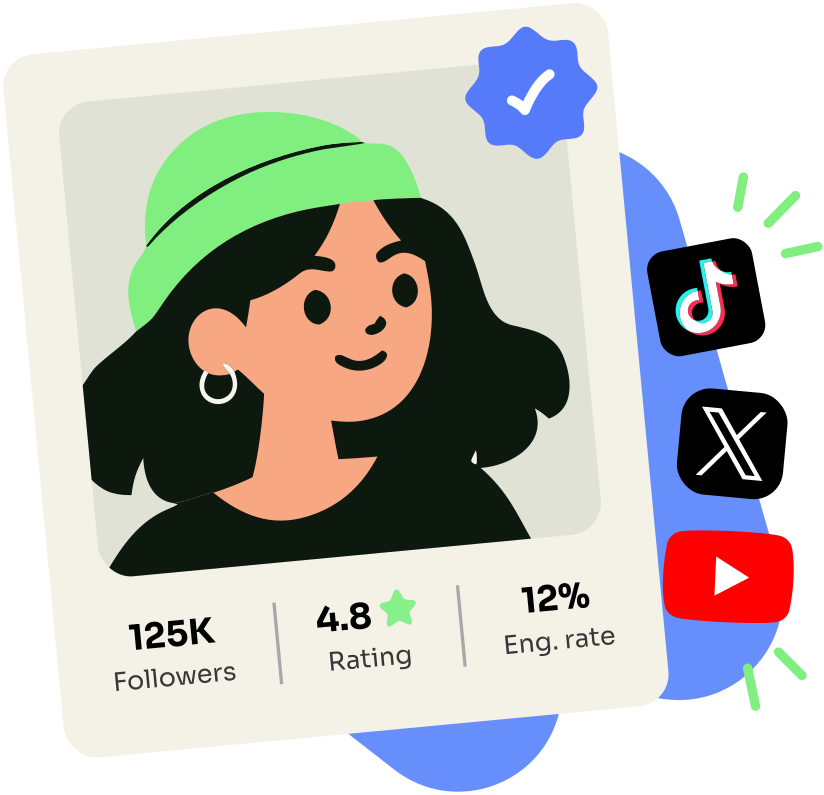
Find and vet creators
Check reach and engagement before you reach out.
Turn video into searchable text
Transcribe and index video and audio content so you can find the exact moment you need.
Track public communities
Follow the subreddits, groups, and channels where your audience talks.
How it works
Your first request in three steps.
Use TypeScript or your automation tool of choice.
Sources
+ 19 more platforms
One request
GET/v1/tiktok/profiles/
x-api-key: sk_live_••••••••
Same JSON shape
{
  "data": {
    "lookupStatus": "found",
    "profile": {
      "platform": "tiktok",
      "handle": "charlidamelio",
      "displayName": "charli d’amelio",
      "verified": true
    },
    "metrics": {
      "followers": 160263648
    }
  }
}
Step 1
Create your free account
Get an API key with 100 requests included.
Step 2
Choose an endpoint
Pass a username, URL, keyword, or post ID.
Step 3
Get clean JSON
Use the response immediately or send it into your pipeline.
Works with your stack
Code, automate, or connect your AI.
 TypeScript
 n8n
n8n- Make
- Apify
- MCP
- AI clients
Pricing
Social data, priced simply.
Start with 100 free credits. Monthly plans give you predictable volume and lower per-request rates.
Starter
18,000credits
$1.61 per 1k · $0.00161 per request
- Top up from $1.61 / 1k if you run out
- Up to 25 monitors
Growth
50,000credits
$1.58 per 1k · $0.00158 per request
- Top up from $1.58 / 1k if you run out
- 5 team seats
- Up to 100 monitors
Scale
150,000credits
$1.50 per 1k · $0.00150 per request
- Top up from $1.50 / 1k if you run out
- 25 team seats
- Up to 250 monitors
- Cancel anytime
- 30-day money-back guarantee
- Price locked while you stay
Need 1M+ credits, invoicing, or volume rates? Talk to us
Trust signals
DevHunt
Product Hunt
Uneed
Customers
Teams building on Social Fetch.
“Our TikTok and Instagram scrapers broke constantly. Social Fetch took us off that rotation — we ship product again.”
“Transcripts at volume from one endpoint. No broken scrapers for our small team to maintain.”
“Live profile data on every request. We never flag accounts from a stale cache.”
“Heavy concurrent load, no rate limits to negotiate. The rare API I haven't wrapped in retries.”
Web API: common questions
What is the Social Fetch Web API?
Five REST routes under the Web tag: public keyword search (GET /v1/web/search), URL to markdown (GET /v1/web/markdown), URL to cleaned HTML (GET /v1/web/html), page Q&A (GET /v1/web/ask), and a bounded multi-URL crawl (GET /v1/web/crawl). Authenticate with a Social Fetch API key. Exact parameters and examples live under /docs/api and on this hub's endpoint list.
Is this a Firecrawl alternative or a full site crawler?
It is Firecrawl-adjacent for single-page markdown, HTML, search, and small batches, not a full crawl-product replacement. Social Fetch crawl accepts up to five URLs you already have and does not follow links or mirror a domain. If you need sitemap map, deep recursive crawl, or crawl-as-a-product depth, use a dedicated web crawl vendor. Use Social Fetch when those pages sit next to social lookups on one marketplace key.
How do I turn a URL into markdown for RAG?
Call GET /v1/web/markdown with a required public url. Optional filter is fit (default, readability-oriented), raw, or bm25 (pass query when using bm25). On lookupStatus: found, read data.markdown. Prefer this route for LLM-ready text; use GET /v1/web/html when you need markup.
How is GET /v1/web/ask different from POST /v1/ask?
GET /v1/web/ask answers a natural-language question about one public page URL (url + q). POST /v1/ask routes a plain-English prompt to social and marketplace operations (profiles, posts, search, and similar). Use web ask when you already have a page URL; use the Ask product when you need a platform lookup routed for you.
Can I search the web before I have a URL?
Yes. GET /v1/web/search takes a required query and returns ranked organic-style results with title, url, and content snippets. Optional region (ISO country code) and datePosted filters localize or narrow by recency. Paginate with 1-based page. Then extract or ask on the URLs you keep.
How much do Web routes cost?
You buy credit packs (or spend the 100 free signup credits). Amounts for markdown, HTML, ask, and search are shown on each endpoint page linked from this hub; bill from meta.creditsCharged. Crawl is 1 credit per URL requested, up to 5 URLs per request (5 credits max). There is no required monthly subscription for pay-as-you-go packs.
Can I crawl an entire website?
No. GET /v1/web/crawl is a bounded synchronous batch: repeat the url query parameter for up to five public URLs you already have. It does not discover or follow links across a domain. Split larger jobs into multiple crawl calls or fetch URLs one at a time with markdown/html.
What does lookupStatus restricted mean?
On markdown, HTML, and ask, restricted means bot or access protection blocked automated fetching. Content fields (markdown, html, or answer) are null. The request can still bill as a completed lookup; read meta.creditsCharged and treat restricted as a hard stop for that URL.
Can Web routes read pages behind a login?
No. Only publicly reachable pages without your session cookies. Private dashboards, paywalled articles, and authenticated app screens are out of scope.
Do Web tools work with MCP and agents?
Yes. The same Web operations appear as typed MCP tools beside social tools when you connect Social Fetch MCP with a key that has credits. For production jobs, pin the typed GET paths so routing stays explicit. POST /v1/ask can still route social lookups; page Q&A stays on GET /v1/web/ask.
The Web API in detailHow the Web routes work, what they cost, and how they differ from the official API.
Why teams use Social Fetch for Web
Social pipelines often need pages beyond profile cards — bio links, pricing pages, docs articles. Social Fetch Web is five HTTP routes under /v1/web/...: keyword discovery, single-URL markdown or HTML, grounded Q&A on one page, and a synchronous batch of up to five known URLs.
GET /v1/web/search returns ranked title / URL / snippet rows. GET /v1/web/markdown and GET /v1/web/html extract one URL. GET /v1/web/ask takes url plus q. GET /v1/web/crawl repeats url up to five times. Responses use lookupStatus where applicable, meta.requestId, and meta.creditsCharged.
The same API key covers the rest of the marketplace catalog (25 platforms, 264 endpoints). Use a dedicated crawl product for unbounded site mirrors or map-first discovery.
How to call the Web API
1. Create a key and smoke-test one URL
Sign up at Social Fetch and copy an
sfk_…key. New accounts get 100 free credits. Start withGET /v1/web/markdown?url=…(or search with a real query) so you seelookupStatus, content fields, andmeta.creditsChargedbefore you wire agents or cron.2. Pick search → extract → ask → crawl
Discover candidates with
GET /v1/web/search. Hydrate keepers withGET /v1/web/markdownorGET /v1/web/html. UseGET /v1/web/askwhen you want one grounded answer without shipping full page text. Pass a short known list toGET /v1/web/crawl(repeaturl, max 5). Passx-api-keyon every call.3. Combine with social tools
Branch on
lookupStatus/ per-URLsuccessbefore writing rows. Store markdown or answers beside social entity ids. Logmeta.requestIdon bad rows. In MCP or agent setups, register Web tools next to profile tools so the model can fetch a bio link after a social lookup.
What each Web route returns
- Public web keyword search: title, URL, and snippet rows with optional region and datePosted filters.
- Single-URL markdown extract with filter modes (
fit,raw,bm25) for RAG and archives. - Single-URL cleaned HTML for DOM parsers, selectors, and markup diffs.
- Page ask: natural-language question about one public URL, grounded answer back.
- Bounded crawl: up to five known URLs in one synchronous request with per-URL results.
- Shared
{ data, meta }envelope and credit wallet with social marketplace routes. - Public pages only: no session cookies, no login walls, no Playwright fleet.
How much does the Web API cost?
Web routes are credit-metered. Single-page markdown, HTML, ask, and search amounts are shown on each endpoint row on this hub (and in the API registry); do not assume every Web call costs the same as every social call. Crawl is metered per URL requested: 1 credit per URL, up to 5 URLs per request (5 credits max). Confirm every response with meta.creditsCharged. Credits never expire on pay-as-you-go packs. Signup includes 100 free credits.
Social Fetch vs the official Web API
Browser automation, proxy scrape APIs, and Firecrawl-style products solve overlapping jobs with different depth. Social Fetch Web is for teams already on the social marketplace who need public page extract, search, ask, and small-batch crawl on the same key. Not a replacement for unbounded site crawl or authenticated sessions.
More platforms on the same key
 Amazon API
 Apple Music API
 GitHub API
 Google API
 Hacker News API
 Linktree API
Pull your first Web data.
Run a live Web request in the playground. 100 free credits, no card, JSON back in seconds.
No credit cardSign up in 30 seconds withGoogleGitHub