

Social Fetch vs Scrapfly
Scrapfly is a developer-focused scraping platform: scrape API, cloud browser, screenshots, and extraction helpers on one credit balance. Social Fetch is a social data API. Both speak HTTP; only one ships TikTok and Instagram as productized endpoints.
- Core product
- Social media data APIWeb scraping API + browser + screenshot + extraction
- Billing
- PAYG packs; Scale $1.64/1kMonthly plans from $30 (Discovery) with credit costs per feature
- Base scrape cost
- 1 credit per completed standard social lookup1 credit datacenter; 25 residential; +5 JS; ASP may upgrade cost
Teams running monitoring, research, and enrichment pipelines


Why Social Fetch
Why teams switch from Scrapfly.
What changes when your social lookups move to one REST API.
One API for 25 platforms
TikTok, Instagram, YouTube, LinkedIn, Reddit, X and more behind one key and one schema — no separate Scrapfly setup per network.
Pricing you can reason about
One completed lookup, one price. Failed lookups aren't billed, so you know how far a balance goes.
JSON in the same request
Fetched live when you ask and returned in the response — ~3.2s on average, no job to poll.
No scraper maintenance
We handle proxies, browser changes, and platform breakages.
Built for production jobs
Run concurrent workloads with explicit statuses and request IDs.
Pay as you go, or save monthly
Start with 100 free credits and no subscription. Pay-as-you-go credits never expire; running lookups every month? A monthly plan gets you lower per-credit rates.
What teams build with Social Fetch
Monitoring, enrichment, research and content workflows — the jobs teams run on Scrapfly, as plain API calls.
Monitor brands and competitors
Watch accounts on a schedule and get a signed webhook when something new posts.
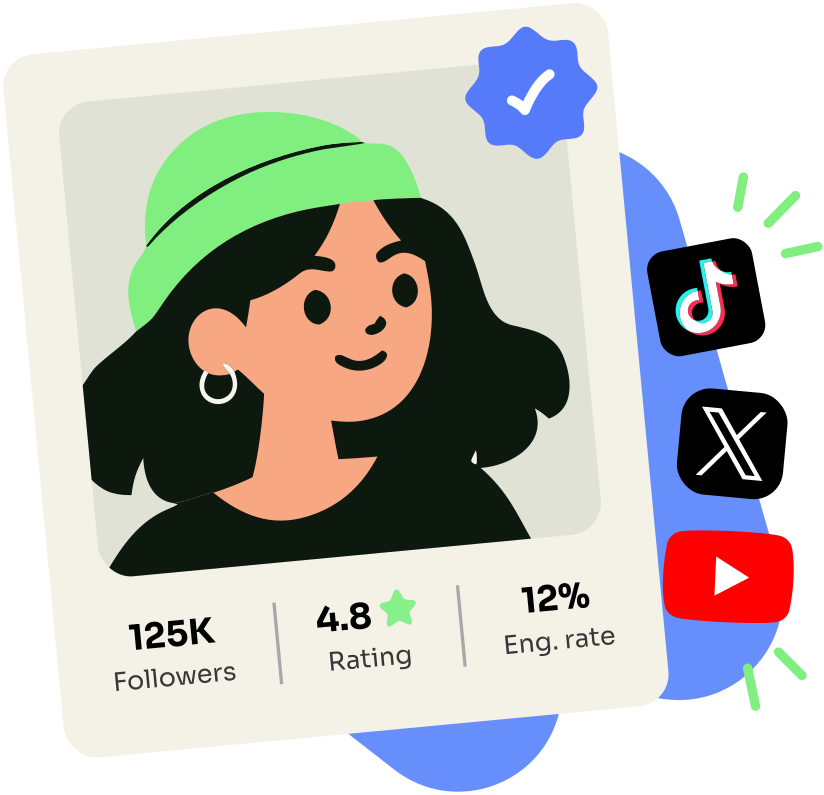
Find and vet creators
Check reach and engagement before you reach out.
Turn video into searchable text
Transcribe and index video and audio content so you can find the exact moment you need.
Track public communities
Follow the subreddits, groups, and channels where your audience talks.
Feature-priced scrape credits vs flat social lookups
Scrapfly: Discovery $30/mo (200k credits), Pro $100/mo (1M). Datacenter 1 credit, residential 25, render_js +5; ASP may raise cost. Residential + JS social pages can hit ~30 credits. Social Fetch: one credit per standard profile lookup.
Free tier
- Social Fetch
- 100 credits, no expiry
- Scrapfly
- 1,000 credits, no card, no time limit
Entry paid plan
- Social Fetch
- $14 PAYG pack (1k credits, never expire)
- Scrapfly
- $30/mo Discovery (200k credits)
Datacenter HTML fetch
- Social Fetch
- N/A
- Scrapfly
- 1 credit (~$0.15/1k on Discovery prepaid math)
Residential + JS page (30 credits)
- Social Fetch
- N/A
- Scrapfly
- ~$4.50/1k pages on Discovery credit math
1,000 structured social profiles
- Social Fetch
- ~$1.64
- Scrapfly
- Variable scrape cost + your schema layer
Failed requests
- Social Fetch
- lookup_failed / 503 not charged
- Scrapfly
- Documented as free on failed scrapes
| Scenario | Social Fetch | Scrapfly |
|---|---|---|
| Free tier | 100 credits, no expiry | 1,000 credits, no card, no time limit |
| Entry paid plan | $14 PAYG pack (1k credits, never expire) | $30/mo Discovery (200k credits) |
| Datacenter HTML fetch | N/A | 1 credit (~$0.15/1k on Discovery prepaid math) |
| Residential + JS page (30 credits) | N/A | ~$4.50/1k pages on Discovery credit math |
| 1,000 structured social profiles | ~$1.64 | Variable scrape cost + your schema layer |
| Failed requests | lookup_failed / 503 not charged | Documented as free on failed scrapes |
Scrapfly prices checked 21 July 2026. How we priced this, with sources
Pricing
Social data, priced simply.
Start with 100 free credits. Monthly plans give you predictable volume and lower per-request rates.
Starter
1,000credits
$14.00 per 1k · $0.0140 per request
- Prove one workflow before you buy more
- All 25 platforms on one API key
Growth
25,000credits
$2.36 per 1k · $0.00236 per request
- For a project or one-off batch job
- Better per-credit rate than the Starter pack
Scale
230,000credits
$1.64 per 1k · $0.00164 per request
- For a large one-time job
- Best pack rate of the three — includes bonus credits
Need 1M+ credits, invoicing, or volume rates? Talk to us
Trust signals
DevHunt
Product Hunt
Uneed
Social Fetch vs Scrapfly, side by side.
How each product expects you to integrate, what you're billed for, and which capabilities come as standard.
Core product
- Social Fetch
- Social media data API
- Scrapfly
- Web scraping API + browser + screenshot + extraction
Billing
- Social Fetch
- PAYG packs; Scale $1.64/1k
- Scrapfly
- Monthly plans from $30 (Discovery) with credit costs per feature
Base scrape cost
- Social Fetch
- 1 credit per completed standard social lookup
- Scrapfly
- 1 credit datacenter; 25 residential; +5 JS; ASP may upgrade cost
Social endpoints
- Social Fetch
- 264 ops / 25 platforms
- Scrapfly
- Any URL — you define extraction
Overflow
- Social Fetch
- Buy another pack
- Scrapfly
- Pro+ can pay-as-you-go extra credits in 10k batches
Best fit
- Social Fetch
- Production social features in your app
- Scrapfly
- Building and operating custom scrapers with managed anti-bot
| Row | Social Fetch | Scrapfly |
|---|---|---|
| Core product | Social media data API | Web scraping API + browser + screenshot + extraction |
| Billing | PAYG packs; Scale $1.64/1k | Monthly plans from $30 (Discovery) with credit costs per feature |
| Base scrape cost | 1 credit per completed standard social lookup | 1 credit datacenter; 25 residential; +5 JS; ASP may upgrade cost |
| Social endpoints | 264 ops / 25 platforms | Any URL — you define extraction |
| Overflow | Buy another pack | Pro+ can pay-as-you-go extra credits in 10k batches |
| Best fit | Production social features in your app | Building and operating custom scrapers with managed anti-bot |
| Capability | Social Fetch | Scrapfly |
|---|---|---|
| Synchronous REST JSON (no actor run polling) | ||
| One API key for all platforms | ||
| Unified schema across platforms | ||
| Public OpenAPI specification | ||
| Official TypeScript SDK | ||
| Interactive API playground | ||
| TikTok, Instagram, YouTube, LinkedIn, Facebook, Reddit, X in one vendor | ||
| Pay-as-you-go without required monthly subscription | ||
| PAYG credits never expire | ||
| Web fetch (markdown/HTML) in same product | ||
| Scheduled account / feed monitors | ||
| Signed webhooks when watched accounts post |
Customers
Teams building on Social Fetch.
“Our TikTok and Instagram scrapers broke constantly. Social Fetch took us off that rotation — we ship product again.”
“Transcripts at volume from one endpoint. No broken scrapers for our small team to maintain.”
“Live profile data on every request. We never flag accounts from a stale cache.”
“Heavy concurrent load, no rate limits to negotiate. The rare API I haven't wrapped in retries.”
Which one should you pick?
If the Scrapfly list sounds like you, Scrapfly is probably the better buy — and that's fine.
Pick Social Fetch if…
- Social profiles and posts are application inputs, not HTML science projects
- You would rather we absorb platform breakage than page your on-call
- Predictable per-lookup pricing without residential credit multipliers
- PAYG social credits beat another monthly scraper subscription for spiky product traffic
- Stable fields matter more than scrape knobs and cost headers
Pick Scrapfly if…
- You are building custom scrapers and want managed anti-bot with visible per-call cost
- Screenshots, cloud browser, or crawler APIs are part of the same workflow
- Targets are mostly non-social sites where datacenter proxies are enough
- You need fine-grained control over proxy pool, geo, and render settings
- Your team already standardized on Scrapfly for general extraction
Social Fetch vs Scrapfly: common questions
Migration, billing surprises, and what changes when you add a second platform.
Is Scrapfly cheaper than Social Fetch?
For simple datacenter HTML, Scrapfly's 1-credit fetches can be far cheaper per page. For social pages that need residential + JS (often ~30 credits), Scrapfly can exceed Social Fetch's $1.64/1k before parsing. Compare the configuration you actually need, not the marketing "credits included" number.
Does Scrapfly have TikTok or Instagram APIs?
You can scrape those sites as URLs. Scrapfly does not replace a social-native endpoint catalog with normalized profile schemas like Social Fetch.
Does Social Fetch expose scrape cost headers?
No. You see credit debits on completed lookups in our billing model. We do not bill by proxy type or render flags because you do not select them.
Can Scrapfly PAYG replace Social Fetch packs?
Scrapfly's extra-credit PAYG is overflow on top of a monthly plan (Pro+). Social Fetch PAYG packs are the primary path and never expire. Different idea of "pay as you go."
Which should AI agents use?
Agents that need arbitrary page content lean Scrapfly (or similar). Agents that need structured social entities lean Social Fetch — fewer tokens spent on HTML and fewer broken selectors.
Do you compete on web markdown fetch?
Social Fetch includes web fetch routes for URL-to-content jobs in the same product, but our primary wedge is social platforms. Scrapfly goes deeper on anti-bot scrape controls for hard general web targets.
The detailed Social Fetch vs Scrapfly comparisonHow Scrapfly works, where the costs come from, and when to keep it.
Scrapfly is strong when you are writing the scraper
Scrapfly's pitch is transparent cost headers, an anti-scraping protection (ASP) mode, cloud browsers, and a single API key across scrape/screenshot/extraction products. For engineers building custom collectors — price monitors, directory crawls, research agents — that toolkit is the product.
You choose proxy pool, rendering, and budgets. The API tells you what each call cost. That level of control is exactly what social-native APIs intentionally hide: you should not need to know whether TikTok needed residential IPs today.
Social pages push you into expensive credit stacks
Public social sites push you into residential + JS — ~30 credits before ASP adjustments (~$4.50/1k on Discovery). Social Fetch Scale: $1.64/1k with parsing done. Easy datacenter HTML looks cheap; social entity pages rarely stay there.
Who owns breakage when Instagram changes
Scrapfly's success criteria is "we fetched the URL." After a layout or anti-bot shift, your Cheerio or Playwright maps fail while Scrapfly still bills a successful page. That is correct for a scrape API — and expensive for a product team on-call.
Social Fetch's success criteria is a documented profile or post object. When a network shifts, we patch extractors; your code keeps reading the same fields. Migrating scrapers that only pull Instagram/TikTok/YouTube metrics usually means deleting field maps and calling GET /v1/{platform}/profiles/{handle}.
Keep Scrapfly for everything that is not a supported social entity.
When to stay on Scrapfly
Stay if you need cloud browser sessions, screenshot APIs, crawler products, or extraction against sites we do not cover. Stay if ASP and cost estimators are how your team operates scrapers day to day.
Switch the social slice when those scrapers have narrowed to "pull Instagram/TikTok/YouTube metrics for the app" and you are tired of credit spikes after anti-bot changes.
Bottom line: Scraper control panel vs social API contract
Scrapfly gives developers levers: proxies, rendering, ASP, cost headers. Social Fetch removes those levers for social data and returns a stable JSON contract instead. If you love operating scrapers, Scrapfly fits. If you want creator and post objects in production, Social Fetch fits. Many teams should use both for different URL classes.
Methodology and sourcesHow we priced each scenario, and where every Scrapfly figure comes from. Checked 21 July 2026.
Sources
Scrapfly pricing from scrapfly.io/pricing and scrapfly.io/docs/scrape-api/billing (July 2026). Credit matrix: datacenter 1, residential 25, render_js +5; ASP may change effective cost. Extra credits billed per 10k on eligible plans.
Scrapfly is a trademark of its owner. Social Fetch is not affiliated with, endorsed by or sponsored by Scrapfly. Details about Scrapfly come from public sources checked on 21 July 2026.
See the response for yourself.
Run a real lookup in the playground before you migrate anything. 100 free credits, no card, and the JSON comes back in the same request.
No credit cardSign up in 30 seconds withGoogleGitHub