Updated 16 Nov 2026. New guide: the YouTube Data API's current quota limits, what each call costs, the June 2026 change that gave search its own bucket, how to get a key and more quota, and what the same jobs cost in credits.
What are the YouTube Data API quota limits in 2026? A new Google Cloud project gets 100 search.list calls a day, 100 videos.insert calls a day, and 10,000 units a day shared by every other method. Most reads cost 1 unit and most writes cost 50. Quotas reset at midnight Pacific Time, and going over returns a 403 quotaExceeded error. Figures from Google's Quota Calculator, checked 16 Nov 2026.
Many guides still say a search costs 100 units and an upload 1,600. Both numbers are out of date. If you only need public channel, video, comment or search data, Social Fetch has no daily quota: a channel lookup is 1 credit, and the free YouTube channel viewer runs on the same data with no login.
YouTube Data API quota limits at a glance
Since 1 Jun 2026 the YouTube Data API has three default quota buckets instead of one. This is the short version, as of 16 Nov 2026.
| Question | Answer (16 Nov 2026) |
|---|---|
| Default shared quota | 10,000 units a day for all methods except search.list andvideos.insert |
| Search | Own bucket: 100 search.list calls a day, 1 unit each |
| Uploads | Own bucket: 100 videos.insert calls a day, 1 unit each |
Typical read (videos.list, channels.list, commentThreads.list) | 1 unit |
| Typical write (comment, playlist edit, rating, thumbnail) | 50 units |
| Daily reset | Midnight Pacific Time |
| Invalid requests | Still cost at least 1 unit |
| Over the limit | HTTP 403quotaExceeded |
| Price | Google lists no price. More quota needs a compliance audit, not a payment |
Each row is sourced in the sections below and in the list at the end.
How much quota does each YouTube API call cost?
Read calls cost 1 unit, most writes cost 50, and caption uploads cost 400 or more. Search and video uploads now sit in their own buckets at 1 unit per call. The costs below are copied from Google's Quota Calculator and method reference pages on 16 Nov 2026.
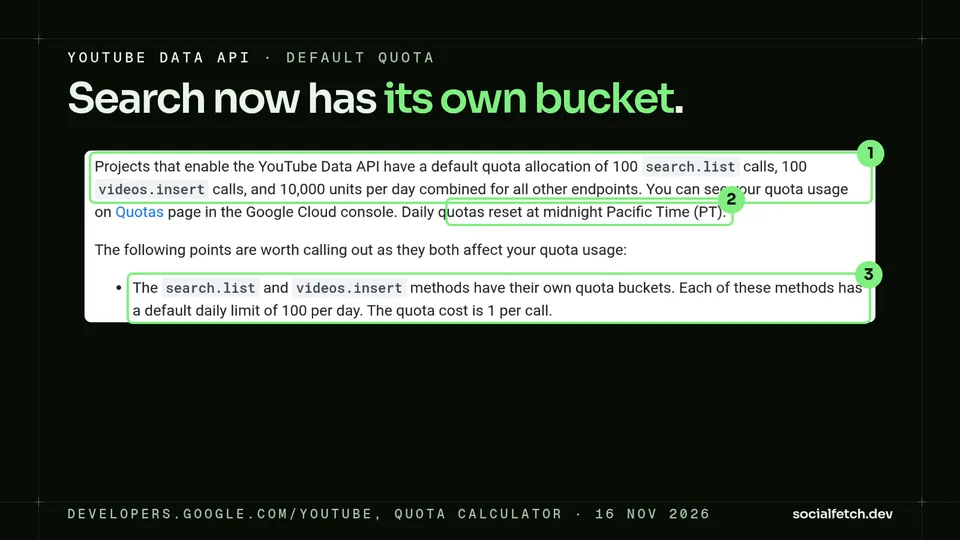
| Method | Cost (16 Nov 2026) | Bucket |
|---|---|---|
search.list | 1 unit per call, 100 calls a day | Search queries |
videos.insert | 1 unit per call, 100 calls a day | Uploads |
videos.list, channels.list, playlists.list,playlistItems.list | 1 | Shared 10,000 |
commentThreads.list, comments.list, subscriptions.list,activities.list | 1 | Shared 10,000 |
liveChatMessages.list | 5 | Shared 10,000 |
comments.insert, commentThreads.insert,playlistItems.insert | 50 | Shared 10,000 |
videos.update, videos.rate, videos.delete,thumbnails.set | 50 | Shared 10,000 |
captions.list | 50 | Shared 10,000 |
captions.download | 200 (needs permission to edit the video) | Shared 10,000 |
captions.insert /captions.update | 400 / 450 | Shared 10,000 |
liveChatBans.insert,liveChatModerators.insert | 200 | Shared 10,000 |
Two rules from the getting started guide change the math. Every request costs at least 1 unit, even an invalid one. And each page of results is a new request, so reading 20 pages of comments costs 20 units, not 1.
Here is what the default quota buys if a project spends it all on one method:
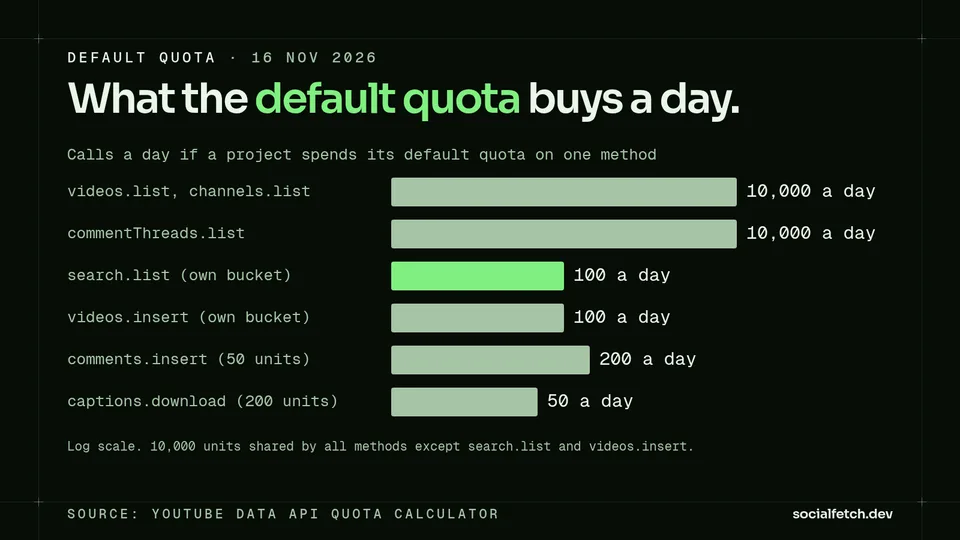
Google also added videos.batchGetStats on 3 Jun 2026, at 1 unit a call in its own bucket with a default of 10,000 units a day, per the revision history.
How do I get a YouTube Data API key?
Create a Google Cloud project, turn on YouTube Data API v3 and create an API key under Credentials. An API key is enough for public data such as video details and search results. Anything that writes, or reads a user's private data, needs OAuth 2.0, per Google's credentials guide (checked 16 Nov 2026).
- Create a project and enable the API
Sign in to the Google Cloud console with a Google Account, create or pick a project, and enable YouTube Data API v3 for it.
- Create and restrict an API key
Open APIs and services, then Credentials, then Create credentials, then API key. Restrict the key to YouTube Data API v3 and to your servers or sites, because the key carries your project's quota.
- Make a 1-unit channels.list call with curl
This looks up a channel by handle and returns its statistics. It costs 1 unit from the shared 10,000.
Request - Run a search from JavaScript
Each
search.listcall takes 1 unit from the 100-a-day search bucket, whatevermaxResultsyou ask for (0 to 50).Request - Page through comments from Python
commentThreads.listreturns up to 100 threads a page for 1 unit. Every extra page is another unit.Request
You can watch usage on the Quotas page in the Google Cloud console.
What happens when you hit the YouTube API quota?
When a bucket is empty, calls to it fail with HTTP 403 and the reason quotaExceeded until the quota resets at midnight Pacific Time. Google's error reference describes it as "you have exceeded your quota" (checked 16 Nov 2026). Because buckets are separate, running out of searches doesn't stop your videos.list calls, and the reverse is also true.
Ways to stretch the default quota:
Use
search.listto find IDs once, then refresh those videos with 1-unitvideos.listcalls from the shared bucket.videos.listandchannels.listtake a comma-separated list of IDs, so one call can refresh several known items.Ask for full pages.
commentThreads.listtakes up to 100 per page andplaylistItems.listup to 50, so fewer pages means fewer units.List a channel's uploads through its uploads playlist with
playlistItems.list(1 unit) instead of searching the channel.Cache responses and skip refreshing data that hasn't changed.
Validate parameters before sending, since a rejected request still costs a unit.
How far does 10,000 units go in a real app?
Further than most guides suggest, as long as you read more than you write. Here is a daily budget we worked out for a tool that tracks 200 public channels, using the costs in the table above.
| Daily task | Calls | Units | Bucket |
|---|---|---|---|
| Find new videos by keyword | 100search.list | 100 | Search (its own 100) |
| Refresh 200 channels' stats | 200 channels.list, one channel each | 200 | Shared |
| Check each channel's uploads playlist | 200playlistItems.list | 200 | Shared |
| Read comments on 50 videos, 10 pages each | 500commentThreads.list | 500 | Shared |
| Reply to 20 comments | 20comments.insert | 1,000 | Shared |
| Total from the shared bucket | 1,900 of 10,000 |
Writes are what drain the shared bucket: those 20 replies cost more than all the channel and playlist reads together. Searching is the hard cap. At 100 calls a day, a tool that needs 500 keyword searches can't do it on one default project.
How do I get more YouTube API quota?
You get more quota by passing a YouTube API Compliance Audit and filing the Audit and Quota Extension Form. There is nothing to buy. Google's Quota and Compliance Audits guide says you must show your project complies with the YouTube API Services Terms of Service before you get more than the default (checked 16 Nov 2026).
| Situation | What to file |
|---|---|
| First request for more quota | Audit and Quota Extension Form. YouTube's API team contacts you |
| Audited in the last 12 months and need more | The same form again |
| Failed an audit or were refused an increase | Appeals Form |
| Your company or project changed hands | Change of Control Form |
Google also runs periodic audits of projects it has already approved. Since 1 Jun 2026, requests are reviewed per method bucket, which Google says simplifies the path to more quota for search or uploads.
How has the YouTube API quota changed?
The biggest change is recent: on 1 Jun 2026 search and uploads moved out of the shared 10,000 units into their own buckets at 1 unit per call. Each row links to Google's revision history unless another source is named.
| Date | What changed |
|---|---|
| 29 Jul 2020 | The extra cost for the part parameter is removed. Calls cost only the method's base cost |
| 1 Jul 2021 | More than the default 10,000 units requires an API Compliance Audit. New Audit and Quota Extension, Appeals and Change of Control forms |
| 4 Dec 2025 | Upload cost changed from about 1,600 units to about 100 |
| 3 Jan 2026 | Quota Calculator still lists search.list at 100 units and videos.insert at 100, both from the shared 10,000 (archived copy) |
| 1 Jun 2026 | Granular quota: search.list and videos.insert get their own buckets. Everything else stays in the shared bucket |
| 3 Jun 2026 | New videos.batchGetStats, 1 unit a call in its own bucket, default 10,000 units a day |
| 2 Nov 2026 | Uploads from unverified API projects are no longer forced to private |
| 16 Nov 2026 | Co-views are counted in public viewCount. A posts resource pilot starts, with public access planned for 2027 |
Under the old rules, 10,000 units bought 100 searches and nothing else. Now the same project can run 100 searches and still spend all 10,000 units on reads.
Is the YouTube Data API free?
Google lists no price for the YouTube Data API, and you don't pay for the default quota. The limit is the quota itself: past it, the only route to more is the compliance audit described above.
Quota belongs to the project. Google's quota docs give the default allocation per project that enables the API, and its credentials guide says an API key identifies your project and provides its access, quota and reports. Set the project up under the account that should own the quota and any future audit.
Free also doesn't mean unlimited in what you may do with the data. The audit checks your use against the YouTube API Services Terms of Service and Developer Policies, so read those before you build anything that stores or resells YouTube data.
What do 1k, 10k and 100k lookups cost?
On the default quota, 10,000 channel or video lookups use a full day of shared units, and 1,000 keyword searches take 10 days of search quota. On Social Fetch the same work is counted in credits and there is no daily cap.
| Volume | YouTube API lookups, 1 per call | YouTube API searches | Social Fetch lookups | Social Fetch search pages |
|---|---|---|---|---|
| Formula | lookups ÷ 10,000 = days | searches ÷ 100 = days | 1 credit per lookup | 1 credit per page |
| 1,000 | 1,000 units, a tenth of a day | 10 days | 1,000 credits | 1,000 credits |
| 10,000 | 10,000 units, 1 full day | 100 days | 10,000 credits | 10,000 credits |
| 100,000 | 100,000 units, 10 days | 1,000 days | 100,000 credits | 100,000 credits |
The YouTube API lookup column assumes one channel or video per call with nothing else spending units. Batching known IDs into one videos.list or channels.list call lowers it, but searches can't be batched. Social Fetch charges per call and failed requests are free, so a page that errors costs nothing. To turn credits into money for your plan, use the estimator on pricing, and for the YouTube side, Google's Quota Calculator.
How do I get YouTube data without quota limits?
Use a public data API. Social Fetch is a REST API for public social data on 57 platforms, with 15 documented YouTube routes under /v1/youtube/.... Almost all cost 1 credit per call; comment analysis is 2, and a transcript is 1 credit when found and free when there isn't one. Costs are from our YouTube endpoint reference for LLMs, checked 16 Nov 2026.
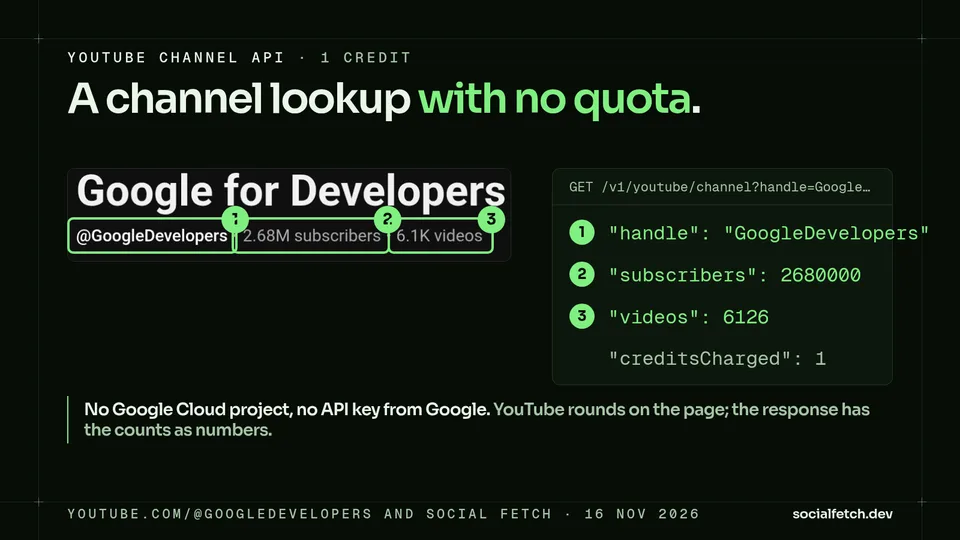
The same lookup from the command line:
A search for the phrase on this page's title returned 45 results in one call for 1 credit:
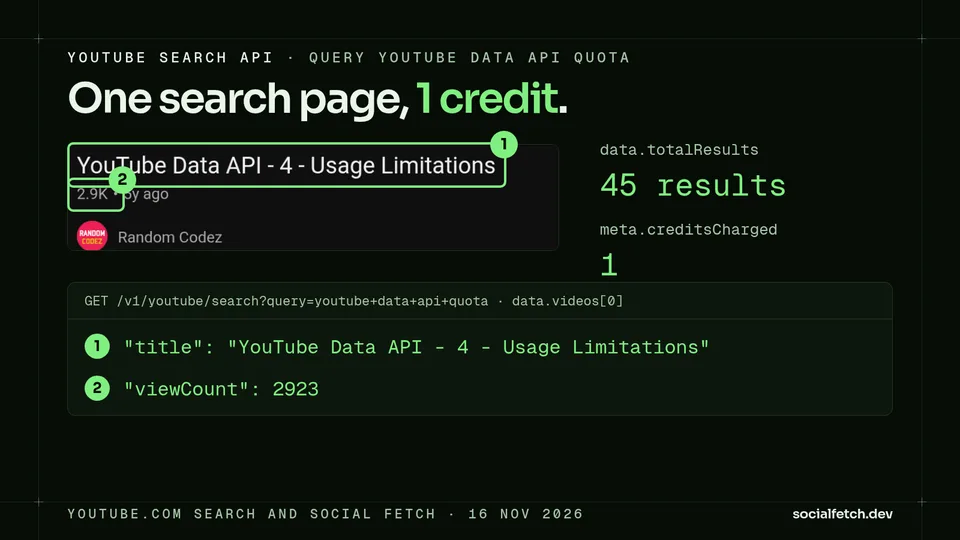
Here is a trimmed copy of that response, values unchanged:
Of those 45 results, 17 were videos, 25 Shorts, 2 playlists and 1 live stream. From JavaScript, pass data.page.nextCursor back as cursor for the next page:
And comments from Python, with no units to count:
New accounts get 100 free credits with no card. AI agents can use the same routes through the Social Fetch MCP server, and every parameter is in the API docs. For transcripts specifically, see the free YouTube transcript API guide.
When to use the YouTube Data API and when to use Social Fetch
Use Google's API when you act for a YouTube user or need their private data. Use Social Fetch when the job is reading public data at a volume the default quota can't carry.
| Job | Best fit | Why |
|---|---|---|
| Upload videos, post comments, edit playlists | YouTube Data API | Needs OAuth and the channel owner's permission. Social Fetch is read-only |
| A user's private data, such as their own subscriptions | YouTube Data API | Needs OAuth |
| Download caption files for videos you manage | YouTube Data API | captions.download needs edit permission |
| Keyword search at scale | Social Fetch | 1 credit a page, no 100-a-day cap |
| Public channel, video and comment data for many channels | Social Fetch | No daily quota or audit |
| Transcripts of public videos | Social Fetch | 1 credit when found, free when not |
| YouTube plus TikTok, Instagram or X in one pipeline | Social Fetch | One key and one schema across 57 platforms |
Social Fetch doesn't upload, post or read private data. For a full side-by-side, see Social Fetch vs the YouTube Data API and the best YouTube data APIs in 2026. If someone asks whether YouTube has an API at all, send them Does YouTube have an API?
How I checked these numbers
Every YouTube quota figure here was read from Google's developer docs on 16 Nov 2026 (pages last updated 12 Nov 2026). Social Fetch numbers come from live calls made the same day.
Default allocation, reset time and per-method costs: Quota Calculator and getting started guide.
search.listbucket andmaxResults: search.list reference.captions.downloadcost: captions.download reference.Errors: YouTube Data API errors.
Audits and forms: Quota and Compliance Audits.
Credentials: Obtaining authorization credentials.
Dated changes: revision history and the 3 Jan 2026 archived calculator.
Social Fetch routes and credits: llms-youtube.txt and the API docs. The channel and search calls above each cost 1 credit on 16 Nov 2026.
Social Fetch service figures: 99.8% uptime over the last 90 days and a 3.2 second average live fetch, as published on status.socialfetch.dev and our homepage on 16 Nov 2026.
I'll recheck Google's quota pages every 30 days and update the date at the top when anything moves.
Frequently asked questions
What is the YouTube Data API daily quota limit?
As of 16 Nov 2026, a new project gets 10,000 units a day for most methods, plus 100 search.list calls and 100 videos.insert calls a day in their own buckets. Quotas reset at midnight Pacific Time.
How many units does a YouTube API search cost?
Since 1 Jun 2026, search.list costs 1 unit from its own bucket of 100 calls a day. Before that it cost 100 units from the shared 10,000, which is why older guides say you get 100 searches a day.
Is the YouTube Data API free?
Google lists no price and doesn't charge for the default quota. You can't buy more quota; you get it by passing an API Compliance Audit and filing the Audit and Quota Extension Form.
How much quota does a video upload use?
Since 1 Jun 2026, videos.insert has its own bucket of 100 calls a day at 1 unit each. Google cut the upload cost from about 1,600 units to about 100 on 4 Dec 2025, before the move to its own bucket.
What happens when I exceed my YouTube API quota?
Calls to the empty bucket fail with HTTP 403 and the reason quotaExceeded until midnight Pacific Time. Other buckets keep working, so running out of searches doesn't block videos.list.
How can I get YouTube data without using quota?
Use a public data API. Social Fetch returns public channels, videos, comments, search results and transcripts with no daily quota, usually for 1 credit per call, and failed requests are free.

The Social Fetch team publishes shipping notes, API design essays, and production post-mortems for developers who need live social and web data without running scrapers.
Related articles
Tutorials
Free YouTube Transcript API With No Key (2026)
 Luke Askew
Tutorials
Unified social media API: TikTok, Instagram and YouTube data in one schema
Social FetchTutorials
Instagram API pricing 2026: costs, limits and access tokens
Luke AskewTutorials
TikTok Transcript API: How to Get Video Transcripts (2026 Guide)
Luke Askew

Questions about this post? Contact us.