
Google Shopping API. Products, sellers and prices as JSON.
Search Google Shopping in any country, then open any result for its details, the stores selling it, its reviews and its daily price history. Every response uses the same envelope.
- Any country
- Sellers + price history
- 1 credit per request
- Failed requests aren't charged
Teams running monitoring, research, and enrichment pipelines


Why Social Fetch
Google Shopping data as JSON. You build the product.
Live Google Shopping data in one response shape, with platform changes handled for you.
Google Shopping, plus every other platform
One key and one response envelope for Google Shopping and 86 more platforms.
API key
sk_live_••••••••















































Pricing you can reason about
One request, one credit. Know how far your balance will go before you run your next batch.
- Requests
- 480
- Credits
- 480
Balance
Live data on every request
Fetch public data when you ask for it.
Nothing to maintain
We handle platform changes and breakages.
Built for production jobs
Run concurrent workloads with explicit statuses and request IDs.
lookupStatus: found
Regular jobs. Better rates.
Running lookups every month? Get lower per-credit rates with a monthly plan. For occasional projects, choose pay as you go.
What Google Shopping data can you get?
5 endpoints, one API key. Every response comes back as live JSON in the same envelope.
Search
Products
Browse all 5 Google Shopping endpoints
Example request
GET /v1/google-shopping/search. Send your API key in the x-api-key header. New accounts get 100 free credits, no card needed.
Example response
A 200 response. Live responses have the same shape with current data.
What teams build with Google Shopping data
Monitoring, enrichment, research and content workflows on Google Shopping data, on the same API as every other platform.
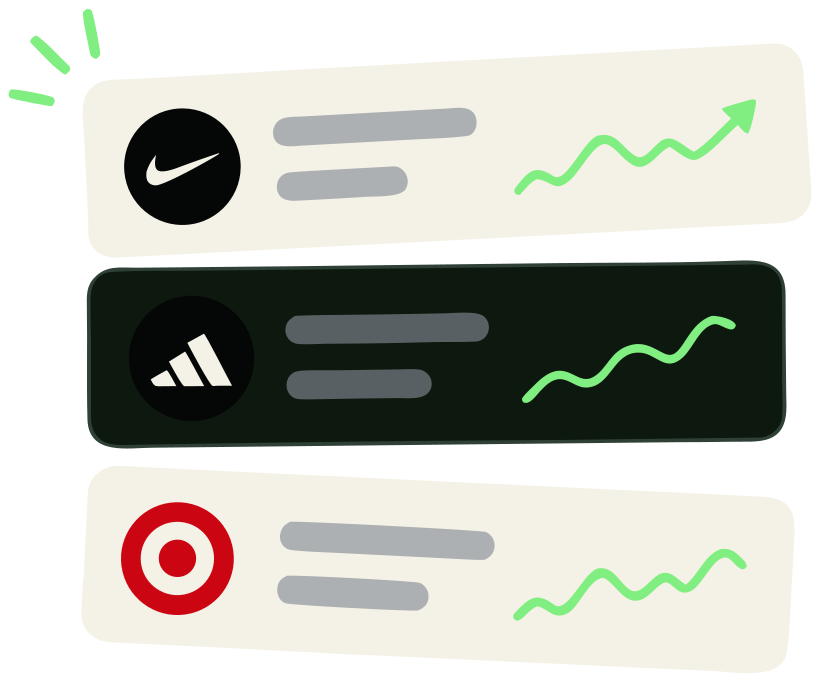
Track prices across stores
Compare every store's price and follow a product's daily price.
Read what buyers say
Star breakdowns and reviews gathered from many stores.
How it works
Your first request in three steps.
Use TypeScript or your automation tool of choice.
API key
sfk_live_••••••••••••
Free requests100
Step 1: Create your free account
Get an API key with 100 requests included.
GET/v2/instagram/profiles/charlidamelio
1 request · 1 credit
Step 2: Choose an endpoint
Pass a username, URL, keyword, or post ID.
200 OK1.82s
{
"handle": "charlidamelio",
"displayName": "Charli D'Amelio",
"followers": 48300000,
"following": 1284
}
Step 3: Get clean JSON
Use the response immediately or send it into your pipeline.
Works with your stack
Code, automate, or connect your AI.
 TypeScript
 n8n
Pricing
Social data, priced simply.
Start with 100 free credits. Monthly plans give you predictable volume and lower per-request rates.
Starter
18,000credits
$1.61 per 1k · $0.00161 per request
- Top up from $1.61 / 1k if you run out
- Up to 25 monitors
Growth
50,000credits
$1.58 per 1k · $0.00158 per request
- Top up from $1.58 / 1k if you run out
- 5 team seats
- Up to 100 monitors
Scale
150,000credits
$1.50 per 1k · $0.00150 per request
- Top up from $1.50 / 1k if you run out
- 25 team seats
- Up to 250 monitors
- Cancel anytime
- 30-day money-back guarantee
- Price locked while you stay
Need 1M+ credits, invoicing, or volume rates? Talk to us
Trust signals
DevHunt
Product Hunt
Uneed
Customers
Teams building on Social Fetch.
“Our TikTok and Instagram scrapers broke constantly. Social Fetch took us off that rotation — we ship product again.”
“A maker pastes one link and Social Fetch fills in their bio and socials. Most of inko runs on it, and it just works.”
Jade P. · Founder, inko “Live profile data on every request. We never flag accounts from a stale cache.”
Hannah Webb · Founder, Scam Finder “Heavy concurrent load, no rate limits to negotiate. The rare API I haven't wrapped in retries.”
Owen Pritchard · Founder, IP Flare
Google Shopping API: common questions
What Google Shopping data can I get from the API?
Search results in any country, with price, earlier price, store, rating, reviews, delivery and returns; and for any product a search returns, its details, the stores selling it with their prices and ratings, its reviews with the star breakdown, and its daily price history with the typical price range.
How do I name a product?
Search first. Every search result carries a productId; pass it unchanged to the product, sellers, reviews and price history routes. The id names the product and the search that found it, so keep the one a search gave you.
Can I search other countries?
Yes. Pass country as a two-letter code such as US, GB or DE, and language such as en or de. Prices, stores, delivery and currency follow the market you name. The default is US in English.
What does not_found mean on a product route?
The search that found the product no longer lists it, so the product can't be opened from it. Search again and use the new productId.
How far back does the price history go?
Up to about a year of daily lowest prices, oldest first, as Google charts it, with the low and high of the price it calls typical. points is empty when Google charts no history for the product.
Do I get every review of a product?
You get the star breakdown across every review and the selection of reviews Google shows. truncated is true when reviewCount is larger than the reviews returned.
Are prices the same for every request?
Google picks prices, stores and delivery for the market you name, and they change through the day, so results move between requests. priceText keeps the price as Google writes it.
How much does the Google Shopping API cost?
Every Google Shopping route charges a flat amount per completed request, shown on each endpoint page, and each page of a search is billed separately. A found, empty or not-found answer is a completed request and costs that amount; invalid requests and errors are free. Check meta.creditsCharged on every response. New accounts start with 100 free credits.
The Google Shopping API in detailHow the Google Shopping routes work, what they cost, and how they differ from the official API.
Why teams use Social Fetch for Google Shopping
GET /v1/google-shopping/search is where the Google Shopping API starts. Search standing desk and each product comes back with its title, price and any earlier price as numbers in the market's currency, the store selling the offer shown, the deal tag, condition, rating, review count, thumbnail and the delivery and returns lines on the card. Name the market with country (US, GB, DE) and the language with language; prices, stores and currency follow them. Follow page.nextCursor for the next page.
Every result carries a productId. Pass it to /v1/google-shopping/product for the brand, description, images, highlights, specifications, lowest price and the price range Google calls typical; to /product/sellers for every store's offer with price, discount, delivery, returns and the store's own rating; to /product/reviews for the star breakdown and the reviews Google shows; and to /product/price-history for the daily lowest price over up to about a year. Every answer is JSON in the { data, meta } envelope with data.lookupStatus.
How to call the Google Shopping API
1. Create an API key
Sign up at Social Fetch and copy a key (
sfk_…). New accounts get 100 free credits, enough to try every Google Shopping route.2. Search, then open a product
Call
GET /v1/google-shopping/search?query=standing%20desk&country=US, pick a product and pass itsproductIdto the product, sellers, reviews or price history route. Sendx-api-keyon every request.3. Branch and page
Check
data.lookupStatusbefore you store a row. Keep searching withpage.nextCursorwhilepage.hasMoreis true, and bill frommeta.creditsCharged.
What each Google Shopping route returns
- Product search in any country and language, with price, earlier price, currency, store, deal tag, condition, rating, review count and thumbnail.
- Delivery, returns and pickup lines for every search result.
- Product details with brand, description, images, highlights, specifications, lowest price and typical price range.
- Every store selling a product, with price, earlier price, discount, condition, delivery, returns, stock and the store's own rating.
- Reviews with the 1 to 5 star breakdown, each review's title, text, rating, author, source site and date.
- Daily lowest price over up to about a year, with the price range Google calls typical.
How much does the Google Shopping API cost?
Each Google Shopping route charges a flat credit amount per completed request, shown on every endpoint page. Each page of a search is its own request. Credits never expire on pay-as-you-go packs, and meta.creditsCharged on every response is the billing source of truth.
Social Fetch vs the official Google Shopping API
Google's own shopping APIs are for merchants managing their own listings, not for reading the results shoppers see. Social Fetch gives every route one JSON shape: prices as numbers with a currency code, plain text, typed lookupStatus answers and opaque ids and cursors. You do not need a Google account.
More platforms on the same key
 Gumtree API
 H&M API
 Home Depot API
Tools and guides
Pull your first Google Shopping data.
Run a live Google Shopping request in the playground. 100 free credits, no card, JSON back in seconds.
No credit cardSign up in 30 seconds withGoogleGitHub