Tutorial · Python
How to scrape Hacker News profiles with Python (2026)
A Python walkthrough for GET /v1/hackernews/users/{username}. Copy the snippet, run it, then read the JSON.
GET /v1/hackernews/users/{username} · 1 credit
In this tutorial
You'll pull a public Hacker News profile and see the fields you get back.
Typical job: looking into an author. Look up a Hacker News username for its karma and about text, then fetch its submissions, comments or favourites only when lookupStatus is found. Useful before you read through a prolific poster's history.
Step 1
Get ready
Create a Social Fetch API key and get Python ready. New accounts include 100 free credits.
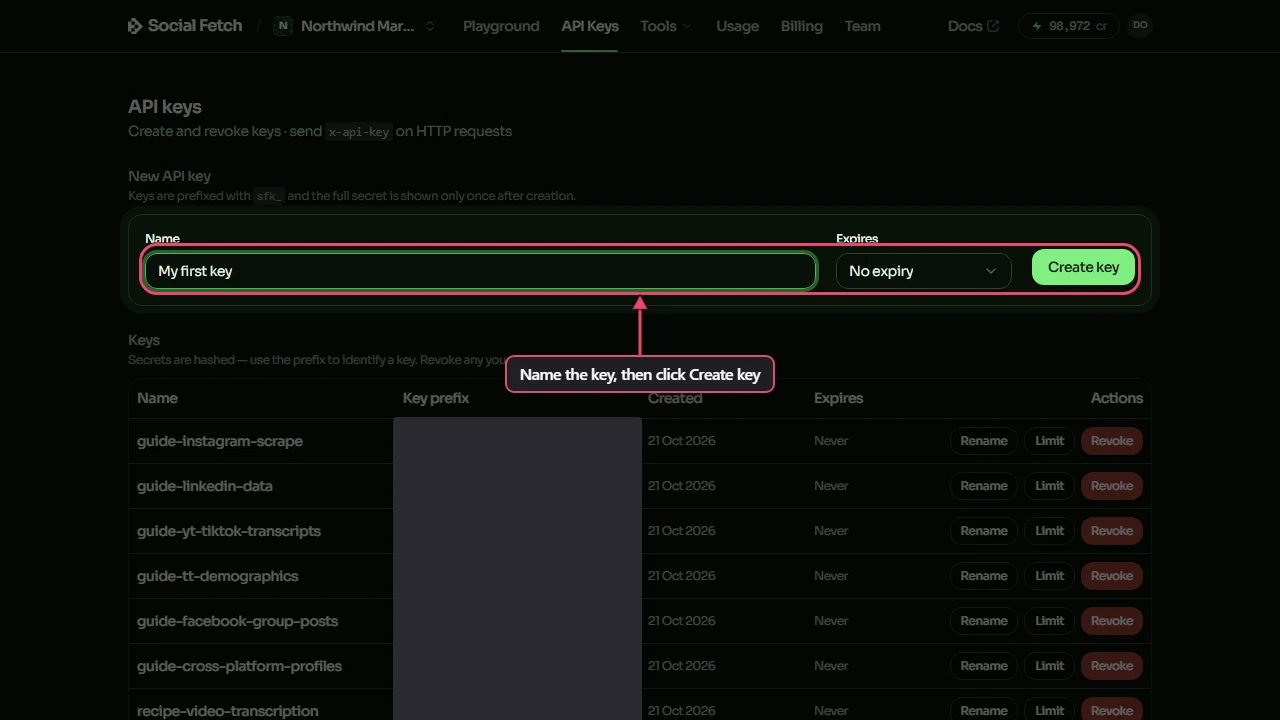
API key. Create a Social Fetch account, open API Keys and create a key. New accounts include 100 free credits.
Python setup. Python 3 with requests installed (pip install requests). Set SOCIALFETCH_API_KEY to your key.
When you're done, SOCIALFETCH_API_KEY is set in your shell.
Step 2
Make the request
Copy the Python sample and run it. It calls GET /v1/hackernews/users/{username} with your key in the x-api-key header, using this example: /v1/hackernews/users/pg.
It prints the response as a Python dict with data and meta. An error status stops the script at raise_for_status() instead.
Step 3
Read the response
The response is JSON with two parts: data holds the profiles and meta holds creditsCharged and requestId. The sample below is a trimmed copy of a real response; the endpoint page lists every field. Credits are charged on completed lookups, not on failed requests.
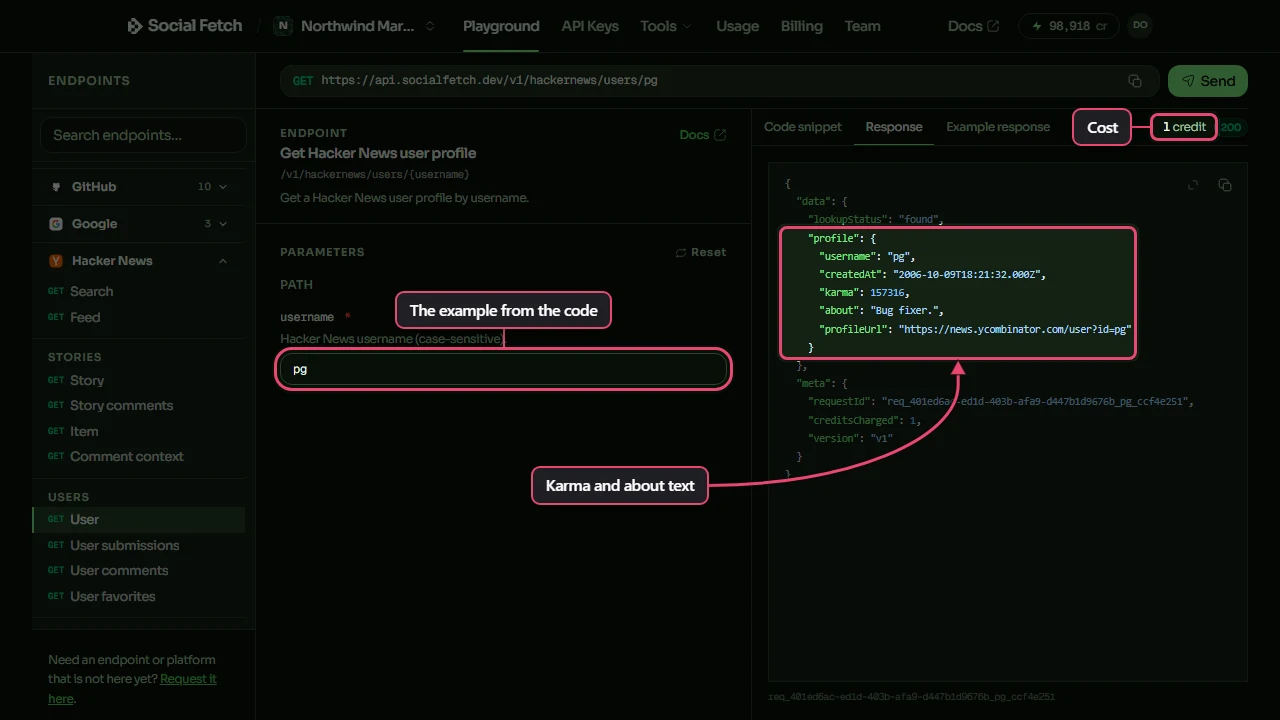
Check data.lookupStatus first when the response has one. Keep meta.requestId in case a row looks wrong.
Watch out
this returns the user only; submissions, comments and favourites are separate calls. not_found means no public user has that name, so don't store an empty row.
Step 4
You finished
The Playground, the docs and your code all call the same endpoint at the same price. Pick a next step below.
FAQ
Common questions
Do I need an official Hacker News developer account?
No. Social Fetch authenticates with your Social Fetch API key. You call GET /v1/hackernews/users/{username} and we handle the lookup. You still need to follow each platform's terms for how you use public data.
What does the Hacker News users endpoint return?
JSON with two parts: data holds the profiles and meta holds creditsCharged and requestId. The endpoint page and the API docs describe every field.
Does the Hacker News user endpoint return submissions?
No. This route returns the user only. For submissions use GET /v1/hackernews/users/{username}/submissions; comments and favourites have their own routes next to it.
What does not_found mean on a Hacker News user?
not_found means no public user has that username, and data.profile is null. HTTP 200 still means the request finished. Check lookupStatus before you write rows.
How much does a successful request cost?
1 credit. Failed requests are free.
Is this okay for production?
Yes. It's the same API the Playground and the docs use: typed errors, a requestId on every response, and credits charged only on completed lookups. New accounts get 100 free credits.
Any Python-specific tips for this request?
Yes. Call response.raise_for_status() before response.json(), set a timeout on requests.get, and keep response.json()["meta"]["requestId"] when a row looks wrong.
Related